Tuesday, September 20, 2011
Philip Willey “Provincial Life “ by Debora Alanna


Unlucky the hero born
In this province of the stuck record
From: “The Times are Tidy” by Sylvia Plath
The Province of the Saved
Should be the Art
From: “The Province of the Saved” by Emily Dickenson
“It is in society that people normally acquire their memories. It is also in society that they recall, recognize, and localize their memories” [1]
Provincial Life is this year’s oeuvre for Philip Willey. An unassuming exposition, this show contrasts existent historical references with the past. He introduces themes from a documented archive, which brings the visual commentary to the forefront and allows drawn and painted portraits intermingling local backdrops to propose a reassessment of history’s recollection that may intensify present processing.
Willey plays with Hannah Maynard’s image, a photographer who challenged photographic space in 1860’s Victoria. She cycles steadily with brandish strokes of lively colour before the Spiral Café, and stopping her bike while merrily collaged, she looks at a photographed excerpt of a John Luna work in bold address of present and future provincialism, a readable argument to thwart any naysayer. An inspired entity defying convention, Maynard provides Willey with a muse.
Soonghees village life with steadfast, carved canoes shored at the current Fort Street waterfront reveals the Blue Bridge in the distance, and in another work, paddlers confront the soon to be bridge or row past a little ferry. Gallantly pointing bows, Willey points to future violations, a portent of life we have overpowered, and the presage of ruin eminent with disregard of what is valuable about our cultural mediums. A biting contrast of whalers next to whale watchers (Moral Dilemma), he drives the lost life forward. Willey postulates the affect of cultural influence. His works are deftly drawn and painted with a wash of colour deferentially shaping nostalgia, both for the past lives lived through our engineered landmarks, soon redefining our mores.
A bike rider pulling a child in a covered yellow rain cart, a symbol of a contemporary urban professionals looks at the viewer with Fort Victoria as their neighbourhood, challenging our outlook with their oblivion. In another work, a horse drawn cart is poised in Bastion square providing imagery to compare past and present scenarios of provincial life. Capable of precise draughtsmanship, when Willey is looser with his lines (Bob’s Your Uncle), he shows how we fumble with history’s lessons. We cannot remember without experience, but we can learn, clumsily.
The Kingdom (2008) by Damien Hirst bares its teeth behind smiling Emily Carr, with Woo, her monkey. Inspired by Hirst’s Spot painting, Willey dots the background of a juxtaposed BC bicycle rickshaw, touring, spotting the sights? In the pale distance, a tall sail is in harbour, reminding us of the passage of time and analogous intention for expedition. Hirst is an interpretation of the monetary credence a prominent sale (Saatchi, for Hirst) can affect the life of an artist, and reminds of Carr’s poverty. Both creatures are out of their habitat, as well. Wooing us with the unfamiliar, challenging our comfort zone poses risk to insular lives. According to Willey’s pictorial interpretation, this financial transaction brings artist and their work from provincial to international status in the public’s perspective. Utilizing Hirst, Willey distinguishes provincial providence with the strength of Hirst reputation, which is communicable.
Willey reveals reflexive aggression with a hammer placed near very delicate teacups, symbolizing a past still present (Tea with Julian). Julian Schnabel smashed his crockery. Willey shatters with associated imagery, demonstrating the calculating transgression of colonialism and pejorative provincialism. By painting aboriginal boaters riding on a moonlit waterway in the tearoom window, Willey reiterates the impact of inaction.
Woman on a Bike (after De Kooning) brings restlessness to Willey’s show. Uneasy, yet breaking out of his placid cerebral visual vocabulary, Willey embraces past influences, allowing his restraint to burst out with arrestingly substantial, attacking strokes and tight composition. De Kooning, along with other European expats were once “provincial artists in a provincial capital, living in the shadow of Europe, who woke up one day in the 1950s to discover that New York was the metropolis of art and they were the unlikely, paint-splattered princes of the city.” Aside from the fame and fortune, De Kooning found this change oppressive. [2] Willey includes the bicycle we found Hannah Maynard riding in several other works to assure continuity, to corroborate that there is consequence to non-provincialism status causing interference to an artist’s journey.
The largest work (Carthage) refers to the North African city founded in Virgil’s Aeneid. Willey exudes a salient, crepuscule timbre that launches a reverie, noting civic improvements that marginalize people, relegating them to boarders of a watery divide. The work is a tribute to Turner who emulated Claude Lorrain. Where in the Lorrain and Turner works there is a tenebrous luminosity, in Willey’s painting, with Willey’s deeply amiable colours shows us his optimism and we anticipate favorable outcome to environmental alteration, in spite of provincial circumspection.
Vanishing Point borrows a De Chirico streetscape where surrounded by a diffused orangey glow, Willey shows examples of historical buildings in isolation and between, segregating past and present, distant trestles creating a provincial surrealism segregating memory, present constructs and future possibility. Willey demonstrates the affect of isolation. The past and present edifices are inaccessible, and we connect with the girl with a hoop, endowing playful abandon necessary for creation. Maybe it’s from Hannah’s bicycle.
Philip Willey found himself in Victoria BC around 40 years ago. “Victoria has been good to me”, he says. Speaking with him, he is ready with a tapestry of stories. One of those world travelers that hobnobbed with soon to be famous artists along the way, Willey has engaged with a veritable whose-who of art icons. A former board member of Open Space Gallery and writer for numerous art magazines while sustaining his art practice, Willey has been, both abroad and here in Victoria in the welcome sphere of provincial life.
Provincial Life
New Paintings by
Philip Willey
Spiral Café
418 Craigflower Ave
Victoria West
6 September – 3 October 2011
Watch video
[1] Halbwachs, Maurice. 1992. On Collective Memory. Trans. And ed. Lewis A. Coser. Chicago: University of Chicago Press.
[2] http://www.robertfulford.com/Dekoonin.html
“ A Myriad of Truths “
Myriad of Truths is a passionate undertaking where synchronistic plots appear in painting and sculpture, divulging illusory stories. Mythos strives to disclose visual legends she senses. Working with mystical knowledge from many cultural inspirations, there are literal and ephemeral references to allusive mystic energies. Bone and feather brings the essence of creation and nature into play, allowing the subjective choices to supersede objectivity with a skill and adoration for how the materials originate. (Tunnel of Eternal Return) Bringing images together with found objects, Mythos layers and develops her personal archetypal narratives. She demonstrates the truth as she experiences it, truth that has a universal realism although the work can be mistaken for cultural appropriation.
In his review (1)of Cultural Appropriation and the Arts by James O. Young (Blackwell Publishing, 2008) John Rapko points out that “cultural appropriation dissolves under scrutiny.” “There is little left for the philosopher to say other than to urge, with Picasso, artists to steal.” A warning about objects or content use by an ‘outsider’ may decrease the “richness, an idea, a style, or a motif; and of a subject or 'voice'” is immaterial in this work because Mythos heightens the viewer’s awareness of primordial forces that dominate a variety of aboriginal cultural arts, allowing her own voice to manifest in authentic intermingling imagery.
An autodidactic artist, Mythos’ production is vigorous and dedicated, although itinerant with each thought process she engages in. However, she adheres to the veracity of the moment, producing ardently with a mostly muted monochromatic palate that writhes with dream-like visions, sharing her consideration and veneration of ancient enquiry processes. A Jack Shadbolt introspection can be seen, yet Mythos’ probing is more eager, an internal investigation that utilizes beings challenging surfaces with combating strokes. Pairing collage sculptural elements with painted surfaces, Mythos assembles her strength’s conviction.
Mythos’ latest work (Rebirth Canal and Ribbed Tunnel of Eternal Return) begins a new exploration with intensely warm colour and unfalteringly feminine shapes. This work projects kindliness with intense assurance, confronting the value of integrity. What will Mythos mythologize next? She has begun to unravel a myriad of truths.
A Myriad of Truths
Artist: ‘Mythos’ aka Tessa Fenger
Olio Gallery
5 – 20 August 2011
614 ½ Fisgard St
Victoria BC
By Debora Alanna
Watch Video
[1] http://ndpr.nd.edu/news/23644-cultural-appropriation-and-the-arts/
In his review (1)of Cultural Appropriation and the Arts by James O. Young (Blackwell Publishing, 2008) John Rapko points out that “cultural appropriation dissolves under scrutiny.” “There is little left for the philosopher to say other than to urge, with Picasso, artists to steal.” A warning about objects or content use by an ‘outsider’ may decrease the “richness, an idea, a style, or a motif; and of a subject or 'voice'” is immaterial in this work because Mythos heightens the viewer’s awareness of primordial forces that dominate a variety of aboriginal cultural arts, allowing her own voice to manifest in authentic intermingling imagery.
An autodidactic artist, Mythos’ production is vigorous and dedicated, although itinerant with each thought process she engages in. However, she adheres to the veracity of the moment, producing ardently with a mostly muted monochromatic palate that writhes with dream-like visions, sharing her consideration and veneration of ancient enquiry processes. A Jack Shadbolt introspection can be seen, yet Mythos’ probing is more eager, an internal investigation that utilizes beings challenging surfaces with combating strokes. Pairing collage sculptural elements with painted surfaces, Mythos assembles her strength’s conviction.
Mythos’ latest work (Rebirth Canal and Ribbed Tunnel of Eternal Return) begins a new exploration with intensely warm colour and unfalteringly feminine shapes. This work projects kindliness with intense assurance, confronting the value of integrity. What will Mythos mythologize next? She has begun to unravel a myriad of truths.
A Myriad of Truths
Artist: ‘Mythos’ aka Tessa Fenger
Olio Gallery
5 – 20 August 2011
614 ½ Fisgard St
Victoria BC
By Debora Alanna
Watch Video
[1] http://ndpr.nd.edu/news/23644-cultural-appropriation-and-the-arts/
Monday, July 18, 2011
John Luna’s Home Show and sale by Debora Alanna


PART 1
Eyes born of night
are not eyes that see:
they are eyes that invent
what we see.
From: The Constellation of the Body
by Octavio Paz. Figures & Figurations (2008)
Permitting an elucidating intimation of intimacy born of layers of meaning, a sampling of John Luna’s previously exhibited painting over the last decade graced the walls of his home for a two-day glimpse this past June. Luna’s pellucid offering was too briefly presented. The time allotted too fleeting. Like a novel that engages you within the first sentence and you must return to at the earliest opportunity, Luna’s work demands further attention. Luna’s art takes time to breathe in - each breath imbibing a persuasive aroma of an intricate, sensuous mystery. Windows of confident tenderness and convincing ache, where indulgence of beauty’s excruciating disposition appears entail more than a peek.
Untitled (Delft Shepherd to Ghost) from Untitled Suite (#5/8) (2000) might be titled to refer to a period of Delft blue faience where glazed earthenware decorated with opaque colors may implicitly direct us to that historical time and place, to a shepherd on a plate in the 1600s, a nostalgic pastoral simplicity, to survival’s necessity. The wagging ghostly finger could be the subtext to shepherding of relationships, or a reference to the movie, “The Good Shepherd” based on Norman Mailer’s book, Harlot’s Ghost. The allusions are all conjecture. We cannot know without asking. The naming of this work suggests how the viewer may enter into thinking about the work. In her essay, “The Critic as Cosmopolite: Baudelaire’s International Sensibility and the Transformation of Viewer Subjectivity”[1], Margueritte Murphy cites Charles Baudelaire’s inquiry into understanding Chinese ceramics:
What would he say, if faced with a product of China—something weird, strange, distorted in form, intense in color and sometimes delicate to the point of evanescence? (…)—it is necessary for him, by means of a phenomenon of the will acting upon the imagination, to learn of himself to participate in the surroundings which have given birth to this singular flowering.
What is important is the ability of the viewer to intervene, to wander in the bucolic. Scouring the surface, unlike Jasper John’s search in Good Time Charley (1961), Luna’s encircling is caring while circumventing exactitude. Perhaps learning its definition, he traverses liberty as he circumscribes Eros, a paling, subtle space. Bulging, blistering blue with familiarity and hope, what is most striking is the luminosity that sings of haunting memories, which cannot be titled.
Buttress (2001) portrays an encumbered, covetous and madly reinforced vigor. Using fierce Franz Kline black, charged ominous rivers streaked with vivid blue vitality washed with pale yellow thrusts between arches of intractable fleshy tenderness. The intermediate is decisive, intervening with separating dominance. Leaning, favouring the brighter, widened curve on the left a spilling of watery xanthous bleeds and diverges to the other marred, withdrawing sphere that seeps out transitory yearning, wistfully.
Drawn in the peripatetic spirit of Dali’s “Catastrophic Writing”, Quatrefoil (2001) is an ominous disclosure where adversity is intertwined within the strengthening structure of the four delineated familial foils, interlocking power. Luna’s roughly stretched thick, palpable fawn painted burlap calls attention to the coarse fabric bite and endurance of the wood support, which holds the uneasy shield. A confused, stained interior of rough, circuitously drawn outlines with meandering marks, awkwardly. Oozing of cobalt infiltrates, articulating the ideal arising from absence:
For his art did expresse
A quintessence even from nothingnesse,
From dull privations, and leane emptiness:
He ruin’d mee, and I am re-begot
Of absence, darkness, death; things which are not.
From: A Nocturnal upon St. Lucie's Day by John Donne
Luna’s East Estuary (2002-2003) is where billowing courses of preoccupied energy meet pressing tides of change. The heat, smarting red infiltrates. Rabbit skin glue pigments under white peeled paper, channeling the widening horizontal waves ripped by underlying crimson, his colour is grounded and mortal. Impasto and tear texture the breakers. Clyfford Still: "I never wanted color to be color. I never wanted texture to be texture, or images to become shapes. I wanted them all to fuse together into a living spirit."
[2]
Luna fuses an emergent surge.
Luna paints silence, a quieted whiteland, where the void is incised by elliptical apertures, sacred Yoni, opening into deified space. Data, Davadhvam, Damyata (2002) cleaves like an avatar, illustrating the personification of virtues described in the Brihadaranyaka Upanishads. In his poem, The Wasteland, T.S. Elliot adopts characters’ qualities from the second Brahmana passage of “The Three Cardinal Virtues”, [3] datta (charity), dayadhvam (compassion) and damyata (restraint). [4] Launching this precept, a path of moral excellence emerges. But Luna includes 4 ellipses [5] in this work. Cut carefully, vertical vacancies in the painted surface readdress the virtuous course, acknowledging human inadequacy. The lowest and nearly determined opening has the remnants of the elliptical cutout hanging. Discerped from virtuous ideals, and dangling, mortality demands a connection between a suspended vision. Needing to know the process is a means to realize what is wanting.
Winter Composition (2003-2004) is a flourishing use of material to build up a stormy palette, inundated with chilly thrashing. Seemingly blithe strokes of sky meander above restlessly smeared, sandy earth. The watery discharge below jumps, cuts and smears into the middle ground from somber suffusion. Amee F. Carmines wrote that Paul Celan explores the ‘frozen rubble of language and humanity, salvaging a warm pulse, even though the carrier of that warmth is banished and burned. He seeks something that can only be found on the edge of silence” [6] I’m wintering over to you. ~ Paul Celan (Snow Part) [7] Luna’s winter swells and thrashes with contrapuntal intensity of harmonious discord. Influencing turquoise is tortuous and pulsating, pervading the central hush – Luna’s brumal season.
Canyon [front] & [verso] has a similar dual existence as Window (2003-2008), Sign (2008-2009) and Messenger (2008 -2009), reviewed on the Exhibit-v blog . [8] Canyon [front] is a chasm where erotic contemplation hovers and becomes a melancholic memory held tight and succinct. Canyon [verso] ties memory, reticulating reason into a grey twist, an entwined prickly tract.
It takes time to absorb John Luna’s paintings. Because he gives you plenty of surface loci to focus and ponder, suggestive materiality to feel, poetic maturity to allow thought divergence, expand insight. And profound scholarly knowledge references to discover, if willing, which will ultimately stimulate further awakening. The looking cannot be rushed. He dissuades cunctation, as his work identifies urgent, purposeful questions that demand concentration, now. Precipitance will prohibit knowing, or what can be known or felt. Feeling is germane. Surfaces are rough, scarred, besieged with colour and incised with distress. The works caress space and we recognize the longing for delicacy of soul’s refinement. Luna’s paintings are strength weighing, stretching fear’s wrapping to breakage, the point of positioned views where past presents and future is possibility.
PART 2
Over a diminutive tajine of salt, bread and Moroccan soup, John Luna spoke about his inspiration, motivation, and art practice. Tumbling ideas, interweaving angulated poetics with quotes, I tried to assimilate each explanation in hyperspeed tangents of thought and I wandered from his original remarks, over and over. Looking at my notebook afterwards, I realized I had only snippets of the conversation written in a scrawl I would barely decipher, having to write at least as fast as John Luna spoke, which was not possible. Using a recording device might have been useful, but would have detrimentally coloured the conversation, I thought. So, I will relay a collage, morsels of Luna’s acumen in no particular order that I managed to learn. His ideas are all with variably specific contexts, and are recorded as faithfully as possible, however, are not transcribed entirely verbatim.
John Luna likes to be at home (big thing), home being where there is an adequate language of relationship, being somewhere and not be there, maybe no where in particular. He refers to Paul Celan’s The Straightening: “no body asks after you”. He says these lines are poetic directions, and “in part, risk language”.
The topic of Jasper Johns’ ruler paintings demonstrate Luna’s attention to use of tools, where he observed an absence and inertia. Inertia resulting when wants, fault, problem, over shooting, and bearing exist. Abandon is a kind of absence, proof you were there, being led array, “an alleviation of burden”.
Luna imparted that your (your – collectively, he uses the collective ‘you’, as opposed to ‘I’ because ‘I’ is a distraction, “pain of ass”. He is uncomfortable with personal, indirectness) dreams are microbes, little lights that expiate burden. Slow insufficiency pours. Homonymy is how dreams work.
He talked about the serious repetitions of gesture. “Being in slipstream feeling.” He relayed the “way of relating to equatorial fatalism” - self secrecy. And mentioned an “anxious, just in case (feeling) vs. compulsion”. He spoke about fear as a transaction. And ethics, which are “hard to make clear”. He speaks about Beuys as a resistant character, and impurity, as the action of Darwin.
Paraphrasing Cezanne: ~ “I will always be the primitive of the path I discover.” ~ Luna explained that in his work, Eros is “a state of tension, all at once available”. Although a distraction, as in Rauschenberg (Luna says). The act of irritating a surface becomes fatigue, tension. Tension is valued. Having a job, task, a reusable one that evolves ~ the temporary doing and undoing of knots. Landscape relocates the crisis/problem history with structure. And can be “danger swapping”.
He refers to 'Bataille' and 'Formless' (referring to Formless: A User's Guide by Yve-Alain Bois and Rosalind E Krauss), an invaluable book for him. He is now reading Krauss, The Optical Unconscious, which he also thinks is great.
He talked about character development, about being an artist/teacher, the stability required to make art with art school as an outlet, providing freedom. And trust. Creating an imaginary social life, as expression - this becomes an “expanding conceit”. Luna relays how relationships shift and how the blurring autonomy of work impacts the domestic setting.
Auspicious and humbling, Luna wants to be “just domestic” make work about the lyric domestic space, disappear into the domestic landscape, and be with the work. Endeavoring to pass into anecdote, he creates persona, and resists insecurity. John Luna is treasure.
PART 3
Giacometti approached, nuzzled by a dark silky guardian. The dog bade him welcome. “John Luna has been waiting for you.” the dog communicated. The tall, walking man’s suspicious eyes approaching the doorway asked, “Why?” Giacometti’s look returned, “Because.”
With a mouthful of home-made steamed baguette dripping with melted butter, Dante appeared in the doorway, beckoning and spoke excitedly from the porch. “In this house dwells a divine comedy. St. Lucy’s eyes are everywhere. Courtly love challenges intimacy lyric.” Upon entering, a quatrefoil was secreted, visible through a glass door, mirroring.
Inside the salon, they faced newly painted grey walls gathering abstracted thought. Straightening the aged estuary canvas, “(It) shows me up better.” Luna grinned. “It peels away memories,” Jasper Johns added, having just coming into the room to join the others.
Having come into the house silently, the others saw him beyond a cut-out aperture to the fore room. Paul Celan spoke, sharing his usual complexities as he turns over one of Luna’s reversible paintings. “Glad to see I can see both side of the questions you pose.”
Smelling of ages, Cezanne floated in, stealthily hovering behind Luna, whispering, “I swear I have seen you somewhere, some winter on the Riviera, perhaps?”
Poking his finger rhythmically through some ellipses, T. S. Elliot shouted to the others from an adjacent canvas, “Dot, dot, dot and into infinity…” (No one could remember exactly when he arrived.)
Baudelaire wandered up the stairs and joined, “There is a shining girl hanging from a tree!” “Let’s drink some of your redolence over coffee and talk.”
Absence is present.
25 & 26 June 2011
Victoria BC
[1] http://www.palgrave.com/PDFs/0230551165.Pdf
[2] Clyfford Still, San Francisco Museum of Modern Art, 1976, p.123
[3] http://www.geocities.com/Athens/Troy/4081/WasteLand.html#431
[4] http://www.archaeologyonline.net/artifacts/east-meets-west.html
[5] “[Greek, ellipsis, a want, defect, ellipsis < to fall short, leave undone > en-, in + leipein, to leave].” Webster’s New World Dictionary. World Publishing Company. 3rd ed. 1958. Print.]
[6] www.unca.edu/postscript/postscript5/ps5.5.pdf
[7] Schneepart (Snow Part), translated by Ian Fairley (2007)
[8] http://exhibit-v.blogspot.com/2010/08/john-luna-tyler-hodgins-storage-room.html


0 comments:
Post a Comment
Thursday, July 7, 2011
Blair Taylor “ You Blew It “ by Debora Alanna


Blair Taylor dreams white dreams of bare efficiency colouring consciousness. Little rises of figures in arrested action impale and huddle, reflect and evince sensation. He delineates and miniaturizes his dreams into equal portions, creating language components, meronymy where isolated parts of dreams relate to his entire dream lexicon. The dreamscapes colligate with size and form. Unnervingly smooth with anonymity, Taylor’s ambiguous figures interplay amongst diverse variations of open architectural configurations. The figures, still as statues from the Abu Temple in Tell Asmar composedly contest. Taylor produces drama within dreamy smooth spaces.
Voyeurs into his dreamworld, we peer into lulling whiteness. Taylor sets his dreams on stark plinths in ordered rows. Taylor’s sculptures can be paralleled to Sandro Bernardi’s assertion about film: 'Il cinema come insiemi infiniti' (infinite sets)[1]. Or scenes like comic book captures that draw tidy, simplified significance with one important dreamed moment, and then another and another. The exhibition space ticks like a silent clock.
Fine, sinister silhouettes summon mysteries’ shadows, contrasting the blanched incidents. Oneiric definition and separation haunts stealthily. Whitened meandering cords suspend white-painted oval speakers narrating. Taylor whispers his dreams into our ears in two locations on the side and end of the exhibition space. Unlike George Segal’s white peopled vignettes, influenced by John Cage to “connect art with tangible reality”, [2] sitting down between Taylor’s undertones, the captivation translates the dreamscapes’ without associating to any particular delineation of his sculpted dreams or our awake world. The auditory sublimates visual wanderings, disengages us from private associations visually presented, developing the pictorial dreams as movie sounds will brings fresh scope to the pictures on screen.
Taylor works small, keeping involvement disconnected in spite of pragmatic building. The events depicted are affectedly dramatic. In her 1999 feature article in Kinema, Oneiric Metaphor in Film Theory, film theorist, Laura Rascaroli writes:
For Jung, dreams develop according to an authentic dramatic structure, formed by a phase of exposition, in which setting and characters are presented; by a development of the plot; by a culmination or peripeteia, containing the decisive event; and by a lysis or solution. [3]
Each of Taylor’s works punctuate with some decisive moment, point of intensity. We are obliged to imagine a resolution. Clarity through simplicity details austere incidents and decorum presupposes we accept that drama will result in a resolve. Preoccupied figures situated in architectural isolation are analogous to painter Paul Delvaux’s Dawn over the City (1940). Unconscious solutions wake a dreamer. Like a Surrealist perplexity, Taylor’s sculptures are subterfuge. [4]
Thinking about Taylor’s numerous stair configurations, there is a structural interrelation to Ilya and Emilia Kabakov’s stage design that transformed Die Tragödie des Teufels (The Tragedy of the Devil) [5] at the Bayerische Staatsoper in Munich in 2010. This opera transported the “Hungarian Faust”, Imre Madách’s The Tragedy of Man into an architectural environment dominated by a prominent luminous white staircase. The stairs conceptualized can signify ascension or descending, a substantial symbol illustrating the timeless struggle to forestall tragedy. “Mankind, it seems, is beset with plenty of inherent evil and requires no outside agency to foment more.” [6] Taylor’s work encourages a devilish bias as many of his sculptures are skewered with quiet violence.
From: There are Crimes and Crimes. (Act 1 Scene 2) by August Strindberg (1899)
MAURICE. Well, if we had to answer for our thoughts, who could
then clear himself?
HENRIETTE. Do you also have evil thoughts?
MAURICE. Certainly; just as I commit the worst kind of cruelties in my dreams. [7]
Through Taylor’s work we collectively experience different versions of unconscious darkness or “Shadow”, an archetypal representation of what disturbs us, about what we do not want known, what we are pained to know and need to know. His use of white distils, counters malevolence. “When it [shadow] appears as an archetype…it is quite within the possibility for a man to recognize the relative evil of his nature…” [8] Utilizing objects (spears, swords and flying projections) for which eroticism is symbolically characteristic, [9] Taylor’s sculpted consciousness is as evocative as Uccello St George impaling his Dragon (1456), a 15th century symbolic through and through of male eroticism, killing ‘sin’, personifying ruin. Taylor stills, piercing ruin’s intensity with an arresting perseverance to remember.
Blair Taylor
" You Blew It"
Art Gallery of Greater Victoria - LAB
22 April - 3 July 2011[1] Sandro Bernardi, 'Il cinema come insiemi infiniti', Filmcritica, 332 (1982), pp. 98-105.
[2] http://www.ngv.vic.gov.au/guggenheim/education/05.html
[3] Serge Lebovici, 'Psychanalyse et cinéma', Revue Internationale de Filmologie, 281 (1948), p. 53
[4] http://www.yuricareport.com/Art%20Essays/SurrealismAndTheUnconscious.html
[5] http://www.ilya-emilia-kabakov.com/index.php/installations/die-tragoedie-des-teufels/description
[6] http://www.nytimes.com/2010/03/03/arts/03iht-Loomis3.html
[7] http://www.gutenberg.org/files/14347/14347-8.txt
[8] C. G. Jung, Aion in The Collected Works of C. G. Jung, ed. William McGuire et al., trans. R. F. C. Hull, Bollingen Series XX (Princeton, N.J.: Princeton University Press, 1954-79) Vol. 9/2, p. 10.
[9] http://www2.arnes.si/~uljfdv15/library/art06.html
Tuesday, June 7, 2011
The Rosen Women, exhibit reviewed by Debora Alanna


Hinda Avery’s billboard sized paintings proclaim a resistance to war, to the Jewish persecution and decimation in the Holocaust or “The Shoah” ([1]), confronting the repercussions of another and very different time and place than we in British Columbia presently experience. With a series of photographically documented wartime events that are reclaimed and reconsidered through buoyant optimism, Avery advances the approach of and need for collective female resistance to the protracted outcome from the Holocaust calamity. The work exhibits actions that combat the oppression of morale, showing how to withstand and counteract the long-term effects of the tyranny and murder of about 7.3 million European Jews at the hands of the Nazis ([2]) and help generations’ consideration to follow. Avery’s work counters the enduring harmful influence of this World War ll slaughter and residual heed to Nazis’ measures by painting the largess of campaigning women that are colourfully strong and infectiously cheerful - familiar and familial.
The Rosen Women upholds and fosters decisive denotations of female resistance fighters. Utilizing photographic portraits, Avery reconstructs the document images onto her canvases. She substitutes her female family’s faces on these painted compositions, keeping the original stance of people experiencing the processing prior to the genocide and on soldiers preparing for war. Additionally, Avery accentuates the women’s features with enlivening smiles.
Avery begins each work with pencil drawings that she leaves visible, while colouring in various details. We witness the piecing together of partial memories. Some more vivid than others. Some just outlines, some vaguely textured with hints of specificity. The bare architectural perspective rendering is unpainted in many places, showing structural layering. Layers build understanding. Avery shows how history’s narratives begin with the simplicity of a thought, a mark.
Avery discharges healing ammunition through the fiery force of expressive opposition to typically haunting war images. Injecting beaming countenances onto the scenes of Nazi invasion, parading explosive happiness in fitness exercise preparation (The Rosen Women working out, just before their advancement on the Nazis), and wielding weaponry to attack oppressors (The Rosen Women – Resistance 1) Avery displaces impassivity with proud determination, asserting joy in passionate resistance. Painting female heads on male physiques of an exercising assembly, Avery asserts an integration of the perceived physical strength of masculinity with female intelligence.
Leafy textures, shadowy garden-like patches that camouflage,
embeding the rifles of the resistance fighter busts (The Rosen
Women in their camouflage) seems to ask questions Blake posed
in his 1793 poem, Visions of the Daughters of Albion:
Tell me what is a thought? & of what substance is it made?
Tell me what is a joy? & in what gardens do joys grow?
And in what rivers swim the sorrows? and upon what mountains
Wave shadows of discontent?
Avery’s camouflaged gardens defend against the rivers of sorrow because her mountainous formations protrude gunning female power.
In War and Popular Culture: Resistance in Modern China, 1937–1945, the author Chang-tai Hung speaks about challenging society to personalize the death and destruction of war by considering the power of female symbology in street theatre. “If the patriotic resistance struggle could somehow be reduced to human terms, if it could be individualized as a person —a flesh-and-blood human being endowed with authentic feelings and experiences—then powerful nationalistic reactions among the people might be evoked… Their ability to understand and identify with the female symbols presented to them, to feel that "she is one of us," was therefore crucial to the success of the play and to the creation of a sense of common heritage and purpose.” ([3]) Avery’s heroines become characters portrayed by her immediate female family members symbolizing moral responsiveness (The Rosen Women – Resistance 2) and (The Rosen Women – Resistance 3). She includes her own portrait amongst these characterizations. Her paintings cultivate the spirit of solidarity with women we can relate to, creating the bridge between subject and viewer. Avery’s work identifies a connection that enables the viewer to aspire to countering oppression, utilizing the painted subject’s comic pathos. We can confront the horror because of Avery paints theatrical cheerfulness.
From the Harold Bloom collection, Literature in the Holocaust, Mark Cory’s essay, Comic Distance in Holocaust Literature (204): “Beyond marking moral boundaries and establishing nuances of credibility in incredible circumstances, the comic in Holocaust literature also functions as resistance, as protest.” ([4]) Establishing authenticity with the composition’s photographic documentation Avery’s comically happy resistance fighters become protestors. Her risible interpretation launches The Rosen Women with resonant integrity, producing an ethically comedic response to the staggering decimation the Holocaust created.
Avery’s subjects release intense curative powers, heightening the complicated and difficult memory of the slain and afflicted. We are shown an accessible way to think of the carnage. Avery challenges us with effusive enthusiasm, painting a vigorous force.
The Rosen Women by Hinda Avery
Martin Batchelor Gallery
712 Cormorant St
Victoria BC
May 28 - 23 June 2011
[1] http://frank.mtsu.edu/~baustin/holo.html
[2] Gilbert, Martin. Atlas of the Holocaust 1988, pp. 242–244).
[3] Hung, Chang-tai. War and Popular Culture: Resistance in Modern China, 1937-1945. Berkeley: University of California Press, c1994 1994. http://ark.cdlib.org/ark:/13030/ft829008m5/
[4] http://www.scribd.com/doc/40067590/10/Comedic-Distance-in-Holocaust-Literature
Tuesday, May 17, 2011
“ Buffet “ review by Debora Alanna
Maître’d: (Curated by) Tyler Hodgins
On the menu: (Artists and sculptures, à la carte)
Ø Megan Dikie 

– Fowl Chic #1, #2, #3 2002. Wax.

Ø Kathryn Ellis 


– Solo 2005. Italian Marble.
Ø David Gifford – Retread 2 2008. Chlorite.


- Colony Collapse 2011. Marble, granite, bronze


- The Bee’s Knees 2011. Wood, wax.
Ø “The Creative Production Division with support from the New School of Inquiry: Domestic Preservation and the Archive & Library Special Collections at the L.S. Benschop Institute for the Preservation & Veneration of Imagination & Nostalgia” (aka Lisa Benschop)
– The Recipe 2011. Wooden recipe box, index card.

Ø Ian Rorie 


- Hunter-Gatherer 2009. Plywood, wire, compact florescent bulb.
Ø Christine Clark 


- Aluminum Circle 2011. A year’s worth of beer cans.
Ø Robert Wise 


- Mold for Ratgnaw 2006. Ceramic, wax residue, photo.
You are what you eat. Who said that first? Was it Jean Anthelme Brillat-Savarin who wrote The Physiology of Taste or Transcendental Gastronomy in 1826 ([1]): "Dis-moi ce que tu manges, je te dirai ce que tu es." (Tell me what you eat and I will tell you what you are.), perhaps? In his introductory note, curator Tyler Hodgins suggests we sample Buffet, select from the courses of work where you can taste an assortment of sculpture. Each idea you savor may reveal something about you, the consumer, in the manner of Brillat-Savarin’s philosophy. The works reveal much about the makers, 6 sculptors that interpose the stark Slide Room exhibition space. Let’s feast!
Entering, Megan Dickie‘s plucky work arrests us. We encounter 3 wax chickens (Fowl Chic #1, #2 and #3 - 2002) molded from reclining, birds prepped for some future gastronomic possibility lounging on low, round IKEA tables. We pause akin to a tableaux vivant. Or is the paused action of the chickens (seemingly conscious of their dramatic solidification) a declaration of Dickie’s detachment forcing us to pull our feathers, sounding our stir of this impudent display with compliments of delight? Unlike Babette’s petted quails, a symbol of a past life in Isak Dineson’s short story, we do not witness the neck breaking, nor the dishing of something epicurean like Cailles en Sarcophage. Dickie’s headless, flightless bird work does inhume sentimentality, waxing potential. And some of us may even pet the cuties. Gobble.
Suddenly, to the far back corner, we spy a spoon shape, an outsized white, seductive marble sculpture carved by Kathryn Ellis. Approaching, we unexpectedly shrink to an Alice miniature after consuming the “Drink Me” bottle. Weighted powerlessness transforms beauty’s consuming repose within a derisory relationship. We look, and consider the seductive attraction to the material, wondering about the capacity that will be required to raise this imposing implement to slurp up the soup (a sturdy course)? A ready comparison exists to the monumental fountain-sculpture Spoonbridge and Cherry (1985-88) by Claes Oldenburg and Coosje van Bruggen in the Minneapolis Sculpture Garden at the Walker Art Center, Minneapolis. Big spoons, both, allow us a standing or walking stance toward an icon of our daily occupancy with what sustains us. Ellis’ work, removed from the pedestal is vulnerable. No bendy handling, no jolly cherry splashes to refresh. Solo scoops up our attention, drawing us to the alluring mat surface ensuring we pay attention to a singularly preserved reality where substantial passion is obscure, smoothly confounded and the story is immobilized. Crunch.
Swerving to the right, is more to tantalize our appetite. Cajoling us with content, David Gifford presents 3 works in close juxtaposition affording a scenario with an inverted chair with wax honeycomb remnants (The Bee’s Knees ), a curvilinear chlorite skid carving turned to its side (Retread 2), and an engraved granite platform holding rosy wall stone pieces askew, with broken bronzed honey combs poised for scrutiny (Colony Collapse). Together, the honey is afoot! The bee’s office chair suited the hive, once, as the leftover comb shards demonstrate. Once excellently habitable, the chair becomes a thing forlorn. What happened? The retreading of a journey? An incised track reestablished the form from is aptness, shaping destiny with domination through processing. And finally, the collapsed colony made memorial, pouring bronze to saturate the honey vessel, the place of industry and awe though with inadvertent placement on a granite squared. Diagonally cockeyed, stone boarders fail to follow function, counterbalancing the weight of regret’s transport. Words inscribed in granite from past works become obfuscated by shadow’s ledge.
Maurice Maeterlinck wrote a book called ‘Le Nid d'Abeilles’ or ‘The Life of the Bee’.
“She (nature) eludes us on every side; she repudiates most of our rules and breaks our standards to pieces. …He (man) has, hitherto, legitimately feared that the attempt to adapt his morality to that of nature would risk the destruction of what was her masterpiece.” ([2])
Gifford juggles, forming structures with features of a struggle that is inward, present and visible that results from his thought provoking actions on material. This sculpture examines convictions, the chaos resulting from revamping ideas within the context of our natures. Sweet. Better than honey.
The Recipe, We all need a recipe. Begin with a recipe. “The Creative Production Division with support from the New School of Inquiry: Domestic Preservation and the Archive & Library Special Collections at the L.S. Benschop Institute for the Preservation & Veneration of Imagination & Nostalgia” (aka Lisa Benschop) exhibits her recipe for Nostalgia in Buffet. Hand written on an index card, placed in a worn wooden recipe box from another era the solitary instructions describe a creative process. Her recipe suggests personal history, gathered with “fondness and nostalgia”, acknowledges the significance of creativity that results in originality when reverential memory triggers imagination. Thinking about some recipes for creation by artists over the years, F.T. Marinetti’s 1932 “The Futurist Cookbook” begins the recipe roster for how to venerably disseminate doctrine creatively. The 2010 “Street Art Cookbook” by Benke Carlsson and Hop Louie also comes to mind as a means to explore a creative processing. In her essay entitled An Aestheic of Nostalgia: Wallace Berman and his Proximity to the Object published in the UBC Undergraduate Journal of Art History Issue 1 | 2010, Sophia Zweifel writes:
“Berman’s works not only simulated a patina of age, but were consciously placed within a history that Berman was constantly in the process of safe-guarding against the changeableness of society. The social, personal, and physical interactions between these pieces and their beholders, helped to construct his group’s identity, one strongly rooted in the shared sense of their own collective present. Along with that sense of a shared moment, however, came the subtle consciousness that this present was constantly being transformed into history.” ([3])
Each artist follows a recipe of their own making, Nostalgia, when mixed well with wakefulness to the present is a technique to create future consideration and becomes the object of nostalgic reflection. Benschop has made her quaint work a podium for an essential undertaking. Recipes are fun to share, imagining what morsels can be made - Mmmm.
From: “Les Fleurs du mal (The Evil Flowers)” by Charles Baudelaire
CXXIII. La Mort des Artistes (The Death of Artists)
(Google Translation)
How many times does it shake my bells
And kiss thy low brow, dismal caricature?
To strike the target, mystical nature
How, O my quiver, losing javelins?
We wear out our souls in subtle plots,
And we demolish many heavy frames,
Before contemplating the great Creature
Whose infernal desire fills us with tears!
There are those who have never known their Idol
And those damned sculptors and marked with an insult,
Who will be pounding his chest and forehead,
Have only one hope, and strange dark Capitol!
“It is Death, hovering like a new sun,
Will grow the flowers of their brain! ([4])
Ian Rorie built Hunter-Gatherer with plywood, and fastened a trap, labeling it, so we would know what lurked inside, lighting the way to entrapment. Sustenance begins with death of some kind. Whether it is the reaping of grain, produce and gathering of the harvest or hunting the animal to produce the sustenance of the meal, there is the death, transformation and nourishment, ultimately. But is this really what is happening here? As Baudelaire points out in his 123rd poem of Les Fleur du Mal, “Death… Will grow the flowers of their brain!” Death, personified as the hold that cannot be captured, grown and gathered will, when we are faced with this fact, allow ideas to manifest. Artists must let imitation or misrepresentation die or die creatively. Rorie presents the diversionary plotting we must struggle with, and face to overcome trepidation. We must hunt out our nemesis, gather our wits, be aware of contrivance and allow our minds to feed us. Be hungry and you will capture what you need.
Thirsty? An ebbing and flowing beckons in the corner of the gallery. Christine Clark’s glistening aluminum disks glimmer as we approach. There is cornering, there is flow from, towards, a stream of overlaid water-like circles, and as Richard Long considered, the beauty of circles are neutral and abstract. Clark’s circles are tiny and part of another formation – Long’s are fashioned from natural material and large in landscape. Nevertheless, Clark’s work does address neutrality and an abstract sensibility. Last month, at the Ministry of Casual Living, Clark displayed this work rising up a wall, ascending in celebration of a year’s abstinence. Neutralizing the cut outs by ensuring no beer labeling exists, Clark objectifies her material and relates a nonjudgmental presence. Abstraction relinquishes past and present. Now the work streams into the gallery, and like a geisha (artist), “But she told me I was like water... Water can carve its way through stone. And when trapped, water makes a new path.” (Sayuri Narration: [while little Chiyo is on the train to the hanamachi], in the movie Memoirs of a Geisha, originally from the novel written by Arthur Golden. This sculptural installation reflects on cessation, how the flow of consumption stills and transforms with time. As the work is now horizontal, transcending enigmatically towards aesthetic idealism, in good company with the forefathers of abstraction ([5]), Clark’s work carves consciousness towards abstracted fulfillment. Soul food.
Bob Wise’s cast for his 2006 Ratgnaw, posthumously exhibited is a fragmented glimpse into his original mind. Buffet presents his ceramic mold, with vestiges of wax drippings used to cast a rat chewed potato, later made into bronze. Honouring Wise’s memory by adding the celebration of past fare to keep memories fresh emphasizes the diversity of the buffet we are partaking of ensuring we “narrow the gap between the act of being and the task of being.” ~ Robert Wise ([6]) Hodgins displays the remnants of Wise’s work process on an altar like table with a photo of the finished work above. Like Vincent van Gogh did when he painted The Potato Eaters (1885), through Wise, Hodgins has us foraging at the community table to feed our ratty hearts. Lots to chew. Epicurus would approve.
[1] http://ebooks.adelaide.edu.au/b/brillat/savarin/b85p/index.html
[2] http://www.gutenberg.org/cache/epub/4511/pg4511.html
[3] http://www.ubcujah.com/wp-content/uploads/2010/11/Sophia-Zweifel.pdf
[4] http://baudelaire.litteratura.com/les_fleurs_du_mal.php ORIGINAL and more translations: http://fleursdumal.org/poem/199
[5] Hilton Kramer, "Mondrian & mysticism: My long search is over", New Criterion, September 1995
[6] Tyler Hodgins. “Buffet”. Exhibition Catalogue, May 2011.
Buffet
Slide Room Gallery
2549 Quadra St
Victoria BC
6 May – 27 May 2011
Wednesday, April 13, 2011
Lance Austin Olsen “ The Road to Esperance “ by Debora Alanna


In the spirit of John Cage’s Notations ([1]), casting the virtual I-Ching with the question “Road to Esperance”, availed the following Cast Hexagram:
45 - Ts’ui / Gathering – The Lake rises by welcoming and receiving Earth’s waters: The King approaches his temple. It is wise to seek audience with him there. Success follows this course. Making an offer will seal your good fortune. A goal will be realized now.
Situation Analysis: This in an important Convergence, and you must be part of it. Look for the Centre of this convergence. Waters running to the sea, like an astronomical convergence of planets revolving around the sun, you should let the gravity of this Centre draw you near. Others are also drawn to this Centre, and among them you will find shared bonds and kindred spirits. This tribal convergence will give you a clarity of purpose. You will no longer be alone.
Plunging in the reverberating reservoir of music/sound notation that Lance Austin Olsen transcribes and/or perspicaciously composes in his exhibition, Road to Esperance is, as Cage describes in his Notations preface,
“A precedent for the absence of information… is the contemporary aquarium (no longer a dark hallway with each species in its own illuminated tank separated from the others and named in Latin): a large glass house with all the fish in it swimming as in an ocean.”
Giving us tremendous pages where sight and sound converge, Olsen draws what sound looks like. Olsen’s current Polychrome exhibition, Road to Esperance, also the title of the first solo release from Infrequency Editions , co-founded by Olsen, and in collaboration with Jamie Drouin and other colleagues, and the title of a handmade artist book could refer to a consigning destination, a system for information transmission - a pipeline, a hope, a confounding entity; his journey is a synchronous commitment to conduction. In this collection of work we survey a narrative that conducts us inscrutably en route, through, just about and off towards a lifting, of confident resonance.
Olsen’s works shown are in two formats. Drypoint engravings from the copper plates incised during soundscape creations, pictographs of sounds in situ combined with the sounds made are august renderings that sing the depths of primordial integrity all called garden. And immense drawings on hefty paper all entitled Pipeline. The latter works are a kind of dream time symbologic mapping. In her curatorial introduction, Sarah Tanguy, curator of Mapping: Memory and Motion in Contemporary Art at the Katonah Museum of Art in January of this year refers to artists’ mapping as
“…a journey into itself that jars our well-worn habits of thinking about place and time.”([2])
Jasper Johns as one of many psychogeographers may have mapped, painted emotional responses to place, however this process seems somewhat 2 dimensional compared to the soundscape mapping of Olsen’s work.
As “a person who walks the city in order to experience it” ([3]), a flâneur, a navigator of sophistication, of culture, or as Pierre Schaeffer describes Concrete music, with the jeu, or playing of something to develop the found sound into music, Olsen transverses the oceans (literally) to accumulate both ambient tremor and timbre as well as his taboo marks – demarcation of the venerated that can only be generated with reverential abstraction. Olsen arranges macro and micro cosmic senses alighting on the brazen & jaunty gently – cantabile. Sincerely gymnastic, Olsen’s mind is at play, sometimes drifting to a smudged photo snapping through scribble or mark, ladder and dotted lines, but with sforzando.
Circumspectly isolating and seizing the way thoughts meander, swatches, scratches and scrawls musically notate. The valiant size of the paper/canvas drawings command and dominate. Uninhibited surface stillness of the prints are lusty and playfully refined, con fuoco, scores that activate, punctuate and lead with darkly extravagant thoughts processing.
Like the grand-master confrontations in Hesse’s Steppenwolf that lead, according to Hesse, to a healing, in Olsen’s work there is the memory of battling, faintly commemorated along with the bright buoyancy of the present and future adventure. In both sets of work compositions reflect the intent of performed musical excision charting his mindful drive that goes nowhere and everywhere, containing and releasing with easy nuance. Marathons of endurance and zest, the surfaces crescendo and ebb, linger, zither and especially, breathe.
We travel through time’s eclipse to resounding gardens of unknown wonder and intimacy. Olsen delineates clarity with conduits articulating the rough punctuations of time while creating space, space between – scratching life’s fetter and drawing lingering inclusions. Arresting, The Road to Esperance is our map to gather at Lance Austin-Olsen’s Centre.
SOUNDS IN A ROOM 3
improvisational performance with Lance Austin Olsen, Jamie Drouin & Mathieu Ruhlmann
Slide Room Gallery
Victoria, Canada
April 29, 2011
All photos from: http://lanceolsen.tumblr.com/
The Road to Esperance
3 April – 28 April 2011
Polychrome Gallery
1113 Fort Street
Victoria BC
[1] http://www.scribd.com/doc/22030514/John-Cage-Notations
[2] http://www.katonahmuseum.org/gedownload!/KMA%20MAPPING%20pre-visit%20packet.pdf?item_id=1570061&version_id=1570062
[3] http://www.eng.fju.edu.tw/Literary_Criticism/postmodernism/postmo_urban/flaneur.html#source
Thursday, March 31, 2011
Roy Green “New Works” by Debora Alanna
 |
| aluminum sunset |
 |
| andy warhol |
 |
| aubergine sky |
 |
| Champion Hi-Park Buddy. |
 |
| Downloader |
 |
| Joseph Beuys |
 |
| misty mountain |
 |
| monsoon |
 |
| moon river |
 |
| Out On A Limb |
 |
| over the hills and far away |
 |
| The Saint |
Walking into an artist’s studio is a privilege. There is a smell of poetry that permeates the psyche. The 2-day invitation to view Roy Green’s New Paintings - unconstrained work, took place where the taste of paint permeates. Breathing in colour, we begin to hear intense birds fluttering and dogs’ countenances, painted outbursts silent, urgent entreating from flushed surfaces striking our eyes. Being a gallery fainéant in the midst of Green’s panorama of paintings is impossibility.
SOCRATES: And there is such a thing as sight?
MENO: Yes.
SOCRATES: And now, as Pindar says, 'read my meaning:'--colour is an effluence of form, commensurate with sight, and palpable to sense.
MENO: That, Socrates, appears to me to be an admirable answer.
SOCRATES: Why, yes, because it happens to be one which you have been in the habit of hearing: and your wit will have discovered, I suspect, that you may explain in the same way the nature of sound and smell, and of many other similar phenomena.([1])
A prolific painter, opening Green’s studio door landscapes up on landscapes balance with more paintings without and with birds (Out on a Limb, e.g.) overlying dogscapes (Champion Hi-Park Buddy, e.g.) and portraits (Joseph Beuys, e.g.) interpose. Naïveté is Green’s intuitive projection where proportion collapses, precision is conciliated. Drawn off colour wipes across scenes of vociferous perspectives and brightens our mood. Erroneous foregrounds juxtapose with detailed backgrounds of kaleidoscope patterns (Downloader, e.g.). Green’s reputable, distinguished oeuvre is playfully copasetic. However, his new work has a novel infiltration of senses.
Although Green has encapsulated enigmatic experiences in The Saint, and Monsoon, for example, Green’s newest work begins by fostering magenta to transform awareness. Thick impasto texturing of Over the Hills and Far Away initiates punctuations of meditation, which again, begets more meditative works where there is balance and poise, stateliness. Grandeur in several small abstracted landscapes evolves calm, salutary realities beyond perception – poetic ideas.
These new works (Aubergine Sky, Moon River, e.g.) have a Schirn Kunsthalle cum Rothko a la Morton Feldman flavour. Green’s confidence speaks and these mature revelations are visualizations of his poetic sensibilities. According to Marshall McLuhan, it was because Rimbaud read Ruskin on the shadowless use of pure colour ([2]) that he found a clarifying title for his book Illuminations. Green’s poem, For Arthur Rimbaud ([3]) mirrors his latest illuminating paintings, dwells on purity and everlasting influence of a noble mind and spirit. Roy Green’s mind and spirit.
Roy Green
New Paintings -Show and Sale
by appt. 250.385.9354
[1] Plato. Meno. 380 B.C.E http://plato.thefreelibrary.com/Meno/2-1
[2] McLuhan, H. Marshall. The Gutenberg Galaxy. 1962. http://books.google.ca/books?id=y4C644zHCWgC&pg=PA267&lpg=PA267&dq=gutenberg+galaxy+poet+rimbaud&source=bl&ots=KGV_AFStSq&sig=RPbNPFTiY4CilNj7565wqbzSynM&hl=en&ei=AeeTTfzQPIKsQPe2vnRBQ&sa=X&oi=book_result&ct=result&resnum=1&ved=0CBkQ6AEwAA#v=onepage&q&f=false
[3] Green, Roy. http://roygreenpoetry.blogspot.com/
Thursday, March 24, 2011
Arash Akhgari - Flying Figures – by Debora Alanna
 |
| Her Gaze |
 |
| Black & Yellow |
 |
| Embodied Float |
 |
| Mirror |
 |
| The Self |
 |
| Trees |
 |
| Untitled |
 |
| Violet Curiosity |
Emerging artists are abundant, however there is much to celebrate when young painter, an autodidactic (not counting a mentor) artist braves the waves of personal resistance to presenting work publically, and has a show in a cafe. Ideally, this is the means to a gallery show – put the work up, and see if the work gets noticed. Arash Akhgari has been noticed.
Akhgari’s canvases are large. Physically, size-wise and expressively. He develops decisive emotions with vast strokes and spacious investigations. Significantly, Akhgari works through ideas of personal inquiry.
In Akhgari’s paintings we see Kirsher and Karl Schmidt-Rottluff-like compositions, emulations of Otto Mueller and Egon Schiele figure positioning with attention to the latter’s finger extensions - Die Brücke (The Bridge) sensibilities. Figure distortions to articulate primitive sensations are prevalent. Akhgari’s colour palates are reminiscent of the war-time monochrome works of Picasso or Braque. Although Akhgari trusts the past to inform his work, he brings his paintings beyond history’s impact, processing his personal narratives with earnest solemnity.
Mirror and Self, although 2 separate works, investigate a self-portraiture with stirring dualities that can be considered through Hegel's comment: "Each consciousness pursues the death of the other.” ([1]) Akhgari paints the exchange or interchange, the knowledge of what he must raze to awaken.
Fond of diptych studies, divided panels bring a revisioning of intent to many of Akhgari’s paintings, creating a relating sequence of imagery that adjusts with the juxtaposing. In Her Gaze and Violet Curiosity, Akhgari plays with perspective. He creates disconcerting relationships between the figures and their position on the canvas – relating the figures to each other and to the contortions of painted space, revealing rooms of visible vestiges of the self. Akhgari’s productive insights allocated to his paintings disclose reflective documents of exploration rather than ebullition. This choice of painterly technique does not minimize the expressive quality of Akhgari’s work.
Akhgari is looking at and assimilating a Western art tradition, which does not quash his origins. Arising from a Persian background, the influence of the deep, remarkable culture where striking ancient and contemporary poetry thrives combined with the interruptions of the strife of war has the power to affect his paintings more inwardly than the cognitive factor of what his intellect dwells on. Yet in spite of these formative currents, at the heart of Akhgari’s work is his self discovery. “Your task is not to seek for love, but merely to seek and find all the barriers within yourself that you have built against it.” ~ Jalal ad-Din Rumi (Persian Poet and Mystic, 1207-1273). Flying Figures moves memory’s illusions towards urgent veracity. Akhgari’s painting, his pictorial reality substantiates his love of the act of painting, of flying into the realm of understanding; he has emerged.
Arash Akhgari
Flying Figures
Penelope's Café
739 Pandora Ave
Victoria BC
17-31 March 2011
[1] Cf. Simone de Beauvoir, (Paris: Gallimard, 1943). It was
translated into English as , translated by Yvonne Moyse
and Roger Senhouse (Glasgow: Fontana/Collins, 1975).
Thursday, March 17, 2011
Aluminum Circle - Christine Clark by Debora Alanna


(From ‘The Walled Garden of Truth’)
“Why, tell me, if what you seek
Does not exist in any place,
Do you propose to travel there on foot?
The road yourself must journey on
Lies in polishing the mirror of your heart.”([1])
Recovery stories are as unique as the recounting of a seemingly shared experience in the Indian legend, the ‘The Blind Men and an Elephant, where the blind men touch an elephant, each a different part (ear, leg, trunk, tail, etc.) and all describe their elephant encounter inimitably. Christine Clark has chosen to exemplify her introspection after a year of sobriety in Aluminum Circle.
Luciano Fabro: “In all cases, use of material has been determined by human experience of which it is an especially able reporter (elasticity, luminosity, transparency, reflection, refraction...). My practical problem is not then that of rendering an otherwise amorphous material aesthetic, but rather that of rendering as clearly as possible the natural dialogue with the material.”([2]) In the 60s, the poetic and elusive Arte Povera sought to expand the boundaries between art and life. This was an art of optimism, belief in the transformative power of art in concert with human endeavor. Arte Povera continues to resonate, and Clark’s work challenges the divide between art and life.
Clark’s utilization of beer cans as material initiates wandering into ideology. Lately, Ecoart manifests through urban living though it still harbours Pop elements these days, where artists employing multiples of the same/similar easily accessed materials, found materials, recycled with the new ‘art’ use along with updated ideology. Unlike Arte Povera, Pop acknowledged consumerism as an icon of social enterprise. Ecoart continues the tradition of recycled material use, now emblems of planetary consumption diverging towards responsibility. Yet personal life is as easily separated as the recyclables. Jessica Jackson Hutchins’s newspaper glued sofa, “Couch for a Long Time” was shown at the 75th Whitney Biennale last February, for example and sustains an objectified view of the impact of a politic. El Anaatsui is renowned for his grand hanging works made of bottle tops, sheaths of splendor that are far more intuitive, yet resonant of consumerism seems to be the origin of his work as the chosen material is always important, referred to first. Aluminum Circle employs the material remnants of a life lived to create an experiential installation, akin to the Arte Povera sensibility. Clark uses used beer can aluminum, yes (and responsibly!). Clark told us so, so we look for the beer labeling – glimpse of labels somewhat familiar overlap the metal discs strewn at the base of the work. Aluminum Circle is so much more. Clark takes us from cans to candor. Honesty is a difficult subject for art, and Clark uses circles in spatial arrangements to describe the essence of growth, rendering the process of encapsulating personal responsibility - a measurement of candour.
At the opening, Clark talked about the shimmering. I thought of a Klimt glimmer, gleam. The premise here is so different. There is no erotic flamboyancy glittering here. Christine presents sensual effervescence, a gentle spirituality. Like Fabro’s ‘Edera’ ([3]), there is upward growth. In Clark’s work, her progression swells with a shimmery spray, bestowing abundance, a delicate, yet tentative vivacity.
Some may say that it is the concept that matters most. Others, that material is where the matter is. And the equation of how the artist lives/lived, what artist utilizes to make or present is subjective and will become objective with the making. What you see in Aluminum Circle is transcendence. Of material. Of hope. Recovered material objectifies a recovered life. Mind over matter. Quite an expanse of thought, of resourcefulness. Of persistence to cut out and pin all those metal discs.
1442 Haultain St.
Victoria, BC
11 – 19 March 2011
[1]
Sanai, Hakim. “The Hadiqa” or “The Walled Garden of Truth”. Octagon Press. 2008
http://www.octagonpress.com/titles/LI/wagapage08.htm
[2] Luciano Fabro cited in exh. cat., Luciano Fabro, Tate Gallery, London 1997, p. 12
Saturday, March 12, 2011
Barrie Szekely “Yardsquare” by Debora Alanna


“Yardsquare”. A Non sequitur. Mischievous, there is care and timeless clarity, a visual amphigory that draws us into Barrie Szekely’s work. We need the essential nonsense he necessitates: “…The artist must be blind to ‘recognized’ and ‘unrecognized’ form, deaf to the teachings and desires of his time. His open eyes must be directed to his inner life and his ears must be constantly attuned to the voice of inner necessity. “ ([1])
Surface skids and breaks within the black on black or stained wood. Brave abandon of delightfully unique living entities compile formations that juxtapose with ovoid configurations. Architecture’s dream or nature’s reminiscence alert, perching with presence. . “…wherever you are, you find the sun, a blade of grass, the spirals of the dragonfly. Courage consists of staying at home, close to nature, which could not care less about our disasters. Each grain of dust contains the soul of something marvellous.”([2])These paintings reveal oblique views of mindful renderings intimately considered. With familial ideas connecting to Miro and Calder, Kandinsky, at least, Szekely discloses indirect aspirations in unhindered moments. Szekely’s work discloses his vision on voids, yards of squaring where volumes of stillness seek to understand. Each work takes time to interact with what acknowledges and sometimes follows the quondam precepts of surrealism and constructivism, for example. In spite of the unease of synaptic glimpses within forms, Szekely slows us down. There is no rush. The work punctuates with uncanny longings, with extraordinary collocation. There is no brisk incision of a Victor Pasmore line, or the ready movement of Eduardo Arranz-Bravo’s non-figurative works. Szekely’s emplacement of form insists on an insurgence of quietude that disarms and we alight on what does not follow rational thought.
A leaf or wisp of feathery branch or the unhurried extension point of a straight line touches the precipice of understanding. Multiples of reverie interplay on wooden square voids, foundations to a vortex of blackness resolutely staying the undercurrent of our habit of speedy consumption. Motionless, disparate demonstrations of creature-like oddities, of nature are tender renderings to marvel, rooting attentive glimpses of abstracted considerations. “It was not that the figure had been removed, not that the figures had been swept away, but the symbols for the figures for the figures, and in turn the shapes in the later canvases were substitutes for the figures… …these new shapes say… …what the symbols said...” ([3])
Unpredictable, Barrie Szekely engages and trumps the resourceful imaginings of the past with dynamic efficiency, propounding hilarious inspirations to envelop the largess of nonsense. Significance intertwines with colour, with shape, with our wits. Preternatural, his work humbles, engaging enigmatic ideals found in any fable. “Modesty is the conscience of the body.” ([4]) Embodied in “Yardsquare” are absurdities that Szekely playfully paints to our cognitive advantage with unpretentious conscientiousness. The non sequitur here requires our diligence to be an enthusiast for what we reluctantly value. “And the old Fishes said, "Above all things, avoid eating a blue boss-woss; for they do not agree with fishes, and give them a pain in their toes."([5])
NB To augment your visual experience with Barrie Szekely’s “Yardsquare,” an astute catalogue essay by John Luna accompanies this Slide Room exhibition.
[1] ”Concerning the spiritual in Art”, Wassily Kandinsky, Munich, 1911
[2] ‘Où allez-vous Miró?’ (Where do you go, Miró), Georges Duthuit in Cahiers d’Art 11, nos. 8-10, 1936; as quoted in “Calder Miró”, ed. Elizabeth Hutton Turner / Oliver Wick; Philip Wilson Publishers, London 2004, p. 40
[3] “Expressionism”, David Anfam, Thames and Hudson Ltd London, 1990, p. 142
[4] de Balzac, Honore. “Comedie Humaine” 1841.
[5] Lear, Edward. “The Habits of the Seven Families” Chapter III. 1894. http://www.gutenberg.org/files/13650/13650-h/13650-h.htm#children
“Yardsquare” - Slide Room Gallery - 2549 Quadra St. -Victoria BC - March 4 to April 4, 2011
Friday, January 28, 2011
Rebekah Johnson ‘The Hamlet Panels’ by Debora Alanna


['Who is watching who is watching you?' Abstracted from the Shakespeare play, Rebekah Johnson's 'The Hamlet Panels' explores the notion of a private life lived publicly, through the use of Plexiglas, fluorescent lights, and security cameras.] from the invitation to this exhibition on Facebook.
“All the world's a stage, And all the men and women merely players…” As You Like It Act 2, scene 7. Oops. Wrong play. Rebekah Johnson is watching us watching as we watch each other watch through films of suspension from video input devices. Her ‘Hamlet Panels’ develop shadowing that bares us, with manipulation. Johnson impressively melds her former scenographer interests with her new juncture of sculptural installation work.
Suspending Plexiglas in 3 sets forms corridors where we are able to be staged by her inventive spacial ploy. Banking florescent lights in rhythmic groupings of 3 x 3 a la a Dan Flavin/Donald Judd combo horizon sets our stage. Although seemingly clear, without duplicity, this wily work has the feeling of entrapment. (‘Mousetrap’ is the name of the play within the play within Hamlet). We can see an influence from Allan Kaprow’s 18 Happenings in 6 Parts, (“The Sandwich Man") from 1959. In 1600ish circa Shakespeare, Giovan Battista Aleotti (1546-1636) introduces the flat (not angled) wing in Ferrara. Johnson explores a long historical allusion to panels in stagecraft.([1]) Johnson’s work unifies these seemingly divergent traditions.
Between two extensions of suspended translucence in the foremost corridor, Johnson has suspended 3 welded rods, a suspended place marking referring to staging, askew - also demonstrating a conspicuous imbalance that marks challenges resulting from the crossing of lineage/space creating a minimized fused bond, physically impenetrable, viewable from the sides without the frontal and back distortion of tough plastic, secure from our walking into this private space. This sequestering of an ‘Intimacy Gradient’ (“The term 'Intimacy Gradient' has become sociological shorthand for 'improving the emotional usability of a social space', after this key passage in Christopher Alexander's essay.”) ([2]) prevents us from trespassing through this inaccessible, intimate passage. This is the heart of the installation. Johnson presents a traversing intent that navigates us into a dialogue about personal connectivity, protecting this attachment in spite of adversity. Again, a theme in Hamlet.
3 security cameras scrutinize our meanderings through her ruse. 3 screens record? or at least reveal the subterfuge of our saunter through her work in a separate, open alcove. Like Hamlet, there is watching; he watches, he is watched, sends others to watch behind tapestries, curtains and other concealment, and most interesting is Hamlet’s cloak of emotional deception. (Hamlet’s Act 1 alone has 15 references to watching.)
The reference to 3s is a direct relation to Shakespeare’s play. Threes galore, there. 3 spells upon the poison to kill a king, a discussion of 3 parts to thought, three chances to kill Hamlet, to name three.
Johnson’s sculptural installation provokes us to engage with the space, other gallery participants/players, and brings us to an emotional stance by her/our need to observe us observing others. There is no complacency.
The seemingly commonplace horizontal lights, covered by opaque Plexiglas (the suffix plex- of Plexiglas means to stroke or strike) bring us round and round and round our crossing between and around panels, guiding us, encouraging us, and simplifying the idea that we are going somewhere. We are getting there. ‘There’ becomes the moment of realization of cameras on the scene. We are struck by her camera invasion into our private movements, as all movements are when noted, especially demonstratively while in a public place.
Early as 1916, the Futurists began involving technology to create a “synthesizing and technological theatrical form”. ([3]) Johnson succeeds in synthesizing theatre and sculpture, employing technology to variegate notions of space, our formalized assumptions and private ventures hung pithily. The elegance and quiet of this work distracts us from a reveal that queries our existence (“To be, or not to be" is the opening line of a soliloquy by Hamlet, Act 3, Scene 1) through impaneling, judged by the screen viewers, at least. Just as Hamlet’s cast is killed off by conjecture, Johnson shows we must not assume that if we can see through something that we see everything.
Fifty-Fifty Arts Collective -13 January to 4 February 2011-2516 Douglas St-Victoria BC
[1] Oscar G. Brockett. History of the Theatre. Boston: Allyn and Bacon, Inc. 3rd edition. 1977.
Kenneth Macgowan and William Melnitz. The Living Stage. Englewood Cliffs, NJ: Pentice-Hall. Inc. 1955
[2] http://www.generalhotel.org/26
[3] Marinetti, Filippo Tommaso (1996) ‘The Founding and Manifesto of Futurism’ (first published in French, 1909). Trans. R.W. Flint. In The Twentieth Century Performance Reader, edited by Michael Huxley and Noel Witts, pp.289-293. London and New York: Routledge
Friday, January 14, 2011
Luis Enrique Oliver “ Baby Gun “ by Debora Alanna

Luis Enrique Oliver’s iconoclastic paintings reel in starburst explosions of socio-political arrays with overt icons of harmlessness. Oliver adeptly paints outsized, beautified babies over miniaturized piles of societal debris and weapons, where guns and tanks etc become toying. One cannot help thinking of Jiang Jie’s Yellow Head sculpture and Xue Song painting, Old China juxtaposed with an Aston Martin in a promo shot by René Staud ([1] as a contrast to Oliver’s appeal for reconsideration of the disquieting relationships to use, misuse and outcome of combat with consumerism. Oliver’s work depicts warfare as the antitheses of credulous potential.
"....art produced by self-taught individuals, usually without formal training, whose works arise from an innate personal vision that revels foremost in the creative act itself."([2]). Oliver’s autodidactic practice allows explorations of styles and techniques while he evolves his own sensibilities. Votive crowns over protagonists, such as seen in Alex Grey’s Dr. Hofmann first synthesized the compound LSD in 1938, while researching ergot derivatives as a chemist for Sandoz Pharmaceuticals in Basel ([3]) are prevalent in these paintings. Mati Klarwein collage techniques are apparent. What is uniquely Oliver is an intense authenticity. Utilizing barbed wire to interplay with embracing Middle East infants on a shard of wood is an arresting image. The paint is unconscientiously applied, and the image cinches and refuses prevarication. Oliver has a drive to respond to confrontational concerns. He has earnest aim towards society’s excessive indulgences, discharges his imagery where complacency is pampered.
http://www.flickr.com/photos/luisenriqueoliver/sets/72157625118182877/“ Baby Gun “ at the Ministry Of Casual Living - Jan. 3 to 12, 201 - 1442 Haultain St.
[1] http://www.astonmartinartcollection.com/meets-art/yellow-head.html
[2] http://www.avam.org/stuff-everyone-asks/what-is-visionary-art.shtml
[3] http://fractalenlightenment.com/20/artwork/alex-grey-beyond-art
Friday, December 3, 2010
Shannon Scanlan’s The Blue Room by Debora Alanna
Shannon Scanlan’s The Blue Room, a sculptural installation at the 50/50 arts collective is not only about the implications of the colour blue. Nor is it only a vacancy, a basic dullish cerulean blue room that we enter. The gallery anteroom or main space becomes the preface to a story, until we chose to cross to the other side. Because Shannon challenges us, creates a narrative with a path to follow, a journey to undertake, a discovery to make.
We need to transverse and duck string strung across the width of the gallery, to follow the prescribed footpath she has demarked. Be in danger of distraction by blatant signage, an Albers-like 2-tone squared centre that encompasses an entire South wall, forcing our diversion from the final destination. If willing, we need to find a channel within the strung string, sectioned for relief or temporary repose. Become frustrated and free when we cross a river of string hung too low for consenting adults to cross without circumventing by stooping, lowering ourselves.
If you remember Antoin Pesvner and those mathematical cohorts of his, we can think of this pink string (pink for contrast in a blue room, the artist says) as a measurement of sorts. Pink is more than a contrast, however. The colour alludes to the pink Pop to come, measuring our tenacity and belief in our (Scanlan’s) narrative. Measuring our willingness to get to the other side. Measuring our compliance to follow a path or forge our own, without breaking the string barrier. Avoiding the trap of staying in the middle reprieve of a wider space between string strung and retreating.
So where are we after our odyssey? Stockholder curtaining brings us into an alcove. Bright with pink lighting and reflective paper cut into rectangular strips splash hot colour and contrast, We are brought to where there is a revelation, a self-discovery of a set of beliefs not quite formed, but felt, a threshold.
Our trek is not quite over. We need to navigate back (yes we must). No longer experiencing an arduous peregrination because we know where we have been, have accomplished tasks to arrive at the consequence of the yarn, we need to leave and reflect on the reflective. Shrewd, The Blue Room is a metaphor for lowered states that will adjunct to another, happier place, with persistence to reroute, even digress. You can see the happy place, but you cannot reach it without belief in your story.
Review by Debora Alanna - Photos by Rory Lambert
THE BLUE ROOM
50/50 Art Collective
2516 Douglas St
Victoria BC
19 November – 8 December 2010
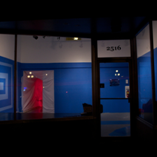


We need to transverse and duck string strung across the width of the gallery, to follow the prescribed footpath she has demarked. Be in danger of distraction by blatant signage, an Albers-like 2-tone squared centre that encompasses an entire South wall, forcing our diversion from the final destination. If willing, we need to find a channel within the strung string, sectioned for relief or temporary repose. Become frustrated and free when we cross a river of string hung too low for consenting adults to cross without circumventing by stooping, lowering ourselves.
If you remember Antoin Pesvner and those mathematical cohorts of his, we can think of this pink string (pink for contrast in a blue room, the artist says) as a measurement of sorts. Pink is more than a contrast, however. The colour alludes to the pink Pop to come, measuring our tenacity and belief in our (Scanlan’s) narrative. Measuring our willingness to get to the other side. Measuring our compliance to follow a path or forge our own, without breaking the string barrier. Avoiding the trap of staying in the middle reprieve of a wider space between string strung and retreating.
So where are we after our odyssey? Stockholder curtaining brings us into an alcove. Bright with pink lighting and reflective paper cut into rectangular strips splash hot colour and contrast, We are brought to where there is a revelation, a self-discovery of a set of beliefs not quite formed, but felt, a threshold.
Our trek is not quite over. We need to navigate back (yes we must). No longer experiencing an arduous peregrination because we know where we have been, have accomplished tasks to arrive at the consequence of the yarn, we need to leave and reflect on the reflective. Shrewd, The Blue Room is a metaphor for lowered states that will adjunct to another, happier place, with persistence to reroute, even digress. You can see the happy place, but you cannot reach it without belief in your story.
Review by Debora Alanna - Photos by Rory Lambert
THE BLUE ROOM
50/50 Art Collective
2516 Douglas St
Victoria BC
19 November – 8 December 2010
Tuesday, October 19, 2010
Aliza Souleyeva-Alexander by Debora Alanna
Kazakhstan born artist Aliza Souleyeva-Alexander imports alluring colour and direct iconography into lush jewels that delve into personally representative universal icons to feed our hunger for meaning. Her persuasive explorations saturate our senses while touching our deeper longing for connectivity. Introspective insights address our trust in her guides to ancient depths of significance. Souleyeva-Alexander’s captivating work enables us to welcome her pictorial stories as verity.
“Bird’s Tales” Paintings explores narratives of how the artist relates to bird myth and legend (Raven Steals the Light), aphorisms that originate from sincere expectation, like the Russian saying, “Magpie has brought news on its tail.” (Conversation with Flamingo) and develops inspired corollary from experiences with birds (Second Night in Kolkata). Homage to art-historical references is unapologetic. Souleyeva-Alexander embraces ominous Rousseau mysteries and widens colour with Matisse joy. “Bird’s Tales” are allegories of pathos and enchantment, captive natures caught in charming fields.
"Aliza 2010" New Works, a visual diary of a year in the artist’s life begins with the winter months on Vancouver Island. Strands of greyed pink and blue rain-beads (Conjunction between Dichotomy and Duality) and triangular, redemptive flags flying in a gratuitous space (Liberation from Formality) or contained arrangement of expectant promise (Hidden Possibilities) interrupt murky washes. In March 2010, Souleyeva-Alexander traveled to Kolkata, West Bengal, India for the "AVISKAR - East meets West" exhibition at the Birla Academy of Arts and Culture. Her work continues to be impacted by this cultural immersion, explodes in influence from the sensory deluge and complex Indian street life. The previous wary ruminations look like memorials, comparatively. A resurgence of her powerful, multi-layered colour palate surges capturing disturbing portrayals – child beggars, the drudgery of rural life. Souleyeva-Alexander mesmerizes us with the intoxication of sultry crimsons and lemony ochre, brilliant indigo, enticing us into the dolorous circumstances and contradictions that entirely signify this cultural paradox. (Morning in Calcutta) is a sophisticated layering of paint and pictograph, harkening to Souleyeva-Alexander’s roots in traditional grattography. Scratching paint, she produces edgy drawing. This grattographic convention provokes the surface. Her pictograms fortify the resonance of bazaar life, remarking on how animals, objects, symbols are remote, illusory yet integral to social convention. Integrated surface dances, conversant with ambiguity and mystique of that locale. (Meditation on Geranium) slathers intoxicating purple and alizarin crimson-like hues, while quietly contemplating her musical past, pasted behind the paint, a formidable memory. Through Souleyeva-Alexander’s paintings, we see a sincere understanding of life fabric, painted with an understated force.
"Bird's Tales" Paintings
Goward House - 2495 Arbutus Road, Victoria, BC (PH: 250.477.4401):
1 Oct - 3 Nov 2010
"Aliza 2010" New Works
Gallery at The Mac - 625 Fisgard Street Victoria, BC:
18 Oct - 22 Nov 2010
Gallery hours: during performances or by appointment (PH: 250.361.0800)
Review by Debora Alanna
“Bird’s Tales” Paintings explores narratives of how the artist relates to bird myth and legend (Raven Steals the Light), aphorisms that originate from sincere expectation, like the Russian saying, “Magpie has brought news on its tail.” (Conversation with Flamingo) and develops inspired corollary from experiences with birds (Second Night in Kolkata). Homage to art-historical references is unapologetic. Souleyeva-Alexander embraces ominous Rousseau mysteries and widens colour with Matisse joy. “Bird’s Tales” are allegories of pathos and enchantment, captive natures caught in charming fields.
"Aliza 2010" New Works, a visual diary of a year in the artist’s life begins with the winter months on Vancouver Island. Strands of greyed pink and blue rain-beads (Conjunction between Dichotomy and Duality) and triangular, redemptive flags flying in a gratuitous space (Liberation from Formality) or contained arrangement of expectant promise (Hidden Possibilities) interrupt murky washes. In March 2010, Souleyeva-Alexander traveled to Kolkata, West Bengal, India for the "AVISKAR - East meets West" exhibition at the Birla Academy of Arts and Culture. Her work continues to be impacted by this cultural immersion, explodes in influence from the sensory deluge and complex Indian street life. The previous wary ruminations look like memorials, comparatively. A resurgence of her powerful, multi-layered colour palate surges capturing disturbing portrayals – child beggars, the drudgery of rural life. Souleyeva-Alexander mesmerizes us with the intoxication of sultry crimsons and lemony ochre, brilliant indigo, enticing us into the dolorous circumstances and contradictions that entirely signify this cultural paradox. (Morning in Calcutta) is a sophisticated layering of paint and pictograph, harkening to Souleyeva-Alexander’s roots in traditional grattography. Scratching paint, she produces edgy drawing. This grattographic convention provokes the surface. Her pictograms fortify the resonance of bazaar life, remarking on how animals, objects, symbols are remote, illusory yet integral to social convention. Integrated surface dances, conversant with ambiguity and mystique of that locale. (Meditation on Geranium) slathers intoxicating purple and alizarin crimson-like hues, while quietly contemplating her musical past, pasted behind the paint, a formidable memory. Through Souleyeva-Alexander’s paintings, we see a sincere understanding of life fabric, painted with an understated force.
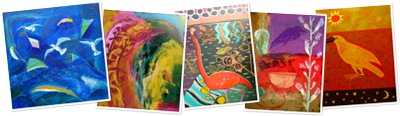
"Bird's Tales" Paintings

Goward House - 2495 Arbutus Road, Victoria, BC (PH: 250.477.4401):
1 Oct - 3 Nov 2010
"Aliza 2010" New Works
Gallery at The Mac - 625 Fisgard Street Victoria, BC:
18 Oct - 22 Nov 2010
Gallery hours: during performances or by appointment (PH: 250.361.0800)
Review by Debora Alanna
Wednesday, August 4, 2010
John Luna & Tyler Hodgins –The Storage Room and The Corridor by Debora Alanna
Tyler Hodgins and John Luna collaboratively manoeuvre us into The Storage Room & The Corridor.
In the front alcove of the gallery, Hodgins fills the space with fresh, factory new square boxes, compiled into various heights, substantially 8 x 8 feet, building towers of possibility. He structures a convenient, operative corridor surround that allows us to peek into the stacks of his deliberate, interconnected modules.
Presented mostly hanging on a wall we meet as we enter the gallery, some in verso and Corridor, suspended without a wall in the adjacent fore space, Luna’s fervent apertures rede delineation. His paintings consume the picture plane with demonstrative sculptural enquiry. Intensity stored, Luna develops a repository of vigilance and poetry, a passageway to disorienting eruptions of entrenched, rasping colour and paroxysmal form.
Hodgins’ work exudes purity and sanguine optimism. Fresh cardboard smells generate cheerful hope with pervasive buoyancy. The boxes are open and await the containment of apposite venture. Sturdily housing the unknown, Hodgins projects alternative echelons of endeavour, intuitively mounted. A companion drawing with the structure inverted is a reflection of his anticipated vision. Hodgins’ converse stance is a playful Gaudi – like preconstruction edifice that cantilevers above to readdress our perspective – transposes the cloistered storeroom to the spiritual attic where prodigious heights amplify qualified space.
Hodgins system of organization and structure can be envisioned using the Bachelard sensibility in the Poetics of Space: “Bachelard uses the physical characteristics of the house in his phenomenological "topoanalysis" to show the house as metaphor for the self...” ([1]) Reflecting on the storeroom in a house, Hodgins Storeroom as self is a system of harmonious, methodical interactions. References and comparisons to artists with cube discovery, like Sol Lewitt - “The system is the work of art; the visual work of art is the proof of the system. The visual aspect can't be understood without understanding the system. It isn't what it looks like but what it is that is of basic importance.” ([2]) or Rachel Whiteread’s appreciation through the "universal quality of the box" ([3]), we find that Hodgins is in good company. He projects his ‘self’ through a configuration of boxes that are patient, unperturbed, and rhythmic. His unhurried composition generates reassuring repose. The luxury of choice (varying heights of box towers) inspires and relieves. Hodgins’ site-specific work acquaints us with the present, imparting a sense of freedom, existing at least for the duration of this exhibition.
Luna provides means of access to what we struggle to know. Intrepid poetry, each work gnaws and squeezes, crushes and substantiates with colour, paper, canvas, wax, wire. He encloses and reframes, edging toward pugnacious rebellion. Sometimes we see the abstracted picture plane; and unpredictably, the ‘verso’. The face copes, allowing the verso to exist in raw aggression and aversion or painful beauty and mystic ardour (Lakeshore). With subverted grays drawing a reluctant closure or finality (Window) and marked scoring, with the eclipse of overpowering vision (Corridor), Luna penetrates fear. Incisions haemorrhage on the reverse (1000 Hrs Later [The Pulmonary Artery - Verso]),(Sign – Verso). “To hell with reality! I want to die in music, not in reason or in prose. People don't deserve the restraint we show by not going into delirium in front of them. To hell with them!” ([4]) Luna’s forthright, rousing accounts consistently assert intense orchestral passion.
Luna’s deference to Rauschenberg and Jasper Johns leads us to understand a history of material manipulation, a Combine. ([5]) However, there is more intuitive handling by Luna, more reverberation tempered by arch vigour. “...allow that the instances of so many things coming together in so rough a way generates its own patina, one that retroactively, inexplicably, forms its own history, legend of beginning, and underlying yield of truth.” ([6]) This quote from Luna’s essay, Pedestrian Colour strategizes one of his working premises. We are permitted long looks into his rationale; his candour supersedes legend of beginning, as his accession to truth is the result of years of investigation, creating an ominous pathos as patina.
Each composition converges and evolves. Suspended thoughts strain and progress, disconnect and refine, elegantly and unpredictably touch and alight significance. “It is true, sometimes the genius loves the strange shapes, but the thinker can read in its arcane figures, discern and know the emphasis of the verse that creates fantastic lightning from a sublime idea.” ([7]) Luna’s work embodies obdurate, audacious perseverance, tenacious investigative prowess, sometimes taking years to perfect the work. He undertakes the protracted risk we impatiently dread and shows us the results that coursing time allows. Luna supplants with cumulative abandon.
Hodgins amassed congress provides furtive circumnavigation where the surrounding corridor keeps activity around the work undisclosed. Privacy, cornering secrecy prevails. Hodgins storeroom monolith creates a welcome isolation. Trusting in the liberating cache, a consequence of his spatial construct, Hodgins affords participants a contracted, reliable retreat.
Luna’s mindscapes are extroverted sanctuaries where he harbours and dissuades, considers and demarcates consuming provocation and impulsion, proliferates in the privacy of introspection. "While working I have never thought of the theme of solitude. I have absolutely no intention of being an artist of solitude. Moreover, I must add that as a citizen and a thinking being I believe that all life is the opposite of solitude, for life consists of a fabric of relations with others...” ([8]) We can consider Luna in relation to Giacometti’s riposte regarding Existentialist readings of his work. Luna has the propensity to exude his acute discernment of life’s interactions and we benefit from his sincerity. ruminating and rebelling; he aligns with disruptive banality The Storage Room & The Corridor is a concerted endeavor. Concurrently, two distinct views of space and time cohesively thrive to showcase concord. The unrelenting, askew squares of painted planar distortions echo unruffled cubed boxes. We see the void of unknown prospects residing along vistas of confrontation. Both artists exhibit authenticity, which binds them. Veracity accumulates and disclosures of new conduits of understanding merge. Hodgins and Luna work in paradoxical alliance.
Tyler Hodgins & John Luna
The Storage Room & The Corridor
16 July - 14 August 2010
Deluge Art Gallery - Victoria BC
[1] Joan Ockman reviews The Poetics of Space by Gaston Bachelard via http://www.gsd.harvard.edu/research/publications/hdm/back/6books_ockman.html [Feb 2005]
[2] http://www.artgallery.nsw.gov.au/exhibitions/archived/2010/kaldor_projects/projects/1977_sol_lewitt
[3] http://news.bbc.co.uk/2/hi/entertainment/4326462.stm
[4] Louis Ferdinand Celine (French writer and physician, 1894-1961)
[5] http://www.lightmillennium.org/2006_17th/rrauschenberg_met.html
[6] John Luna. Pedestrian Colour: http://www.slideroomgallery.com/PEDESTRIAN%20COLOUR%20Essay.pdf
[7] Poesie e novelle in versi, by Ferdinando Fontana, 1877: http://www.gutenberg.org/etext/9642
[8] P. Selz, New Images of Man, exh. cat., The Museum of Modern Art, New York, 1959, p. 11

In the front alcove of the gallery, Hodgins fills the space with fresh, factory new square boxes, compiled into various heights, substantially 8 x 8 feet, building towers of possibility. He structures a convenient, operative corridor surround that allows us to peek into the stacks of his deliberate, interconnected modules.
Presented mostly hanging on a wall we meet as we enter the gallery, some in verso and Corridor, suspended without a wall in the adjacent fore space, Luna’s fervent apertures rede delineation. His paintings consume the picture plane with demonstrative sculptural enquiry. Intensity stored, Luna develops a repository of vigilance and poetry, a passageway to disorienting eruptions of entrenched, rasping colour and paroxysmal form.
Hodgins’ work exudes purity and sanguine optimism. Fresh cardboard smells generate cheerful hope with pervasive buoyancy. The boxes are open and await the containment of apposite venture. Sturdily housing the unknown, Hodgins projects alternative echelons of endeavour, intuitively mounted. A companion drawing with the structure inverted is a reflection of his anticipated vision. Hodgins’ converse stance is a playful Gaudi – like preconstruction edifice that cantilevers above to readdress our perspective – transposes the cloistered storeroom to the spiritual attic where prodigious heights amplify qualified space.
Hodgins system of organization and structure can be envisioned using the Bachelard sensibility in the Poetics of Space: “Bachelard uses the physical characteristics of the house in his phenomenological "topoanalysis" to show the house as metaphor for the self...” ([1]) Reflecting on the storeroom in a house, Hodgins Storeroom as self is a system of harmonious, methodical interactions. References and comparisons to artists with cube discovery, like Sol Lewitt - “The system is the work of art; the visual work of art is the proof of the system. The visual aspect can't be understood without understanding the system. It isn't what it looks like but what it is that is of basic importance.” ([2]) or Rachel Whiteread’s appreciation through the "universal quality of the box" ([3]), we find that Hodgins is in good company. He projects his ‘self’ through a configuration of boxes that are patient, unperturbed, and rhythmic. His unhurried composition generates reassuring repose. The luxury of choice (varying heights of box towers) inspires and relieves. Hodgins’ site-specific work acquaints us with the present, imparting a sense of freedom, existing at least for the duration of this exhibition.
Luna provides means of access to what we struggle to know. Intrepid poetry, each work gnaws and squeezes, crushes and substantiates with colour, paper, canvas, wax, wire. He encloses and reframes, edging toward pugnacious rebellion. Sometimes we see the abstracted picture plane; and unpredictably, the ‘verso’. The face copes, allowing the verso to exist in raw aggression and aversion or painful beauty and mystic ardour (Lakeshore). With subverted grays drawing a reluctant closure or finality (Window) and marked scoring, with the eclipse of overpowering vision (Corridor), Luna penetrates fear. Incisions haemorrhage on the reverse (1000 Hrs Later [The Pulmonary Artery - Verso]),(Sign – Verso). “To hell with reality! I want to die in music, not in reason or in prose. People don't deserve the restraint we show by not going into delirium in front of them. To hell with them!” ([4]) Luna’s forthright, rousing accounts consistently assert intense orchestral passion.
Luna’s deference to Rauschenberg and Jasper Johns leads us to understand a history of material manipulation, a Combine. ([5]) However, there is more intuitive handling by Luna, more reverberation tempered by arch vigour. “...allow that the instances of so many things coming together in so rough a way generates its own patina, one that retroactively, inexplicably, forms its own history, legend of beginning, and underlying yield of truth.” ([6]) This quote from Luna’s essay, Pedestrian Colour strategizes one of his working premises. We are permitted long looks into his rationale; his candour supersedes legend of beginning, as his accession to truth is the result of years of investigation, creating an ominous pathos as patina.
Each composition converges and evolves. Suspended thoughts strain and progress, disconnect and refine, elegantly and unpredictably touch and alight significance. “It is true, sometimes the genius loves the strange shapes, but the thinker can read in its arcane figures, discern and know the emphasis of the verse that creates fantastic lightning from a sublime idea.” ([7]) Luna’s work embodies obdurate, audacious perseverance, tenacious investigative prowess, sometimes taking years to perfect the work. He undertakes the protracted risk we impatiently dread and shows us the results that coursing time allows. Luna supplants with cumulative abandon.
Hodgins amassed congress provides furtive circumnavigation where the surrounding corridor keeps activity around the work undisclosed. Privacy, cornering secrecy prevails. Hodgins storeroom monolith creates a welcome isolation. Trusting in the liberating cache, a consequence of his spatial construct, Hodgins affords participants a contracted, reliable retreat.
Luna’s mindscapes are extroverted sanctuaries where he harbours and dissuades, considers and demarcates consuming provocation and impulsion, proliferates in the privacy of introspection. "While working I have never thought of the theme of solitude. I have absolutely no intention of being an artist of solitude. Moreover, I must add that as a citizen and a thinking being I believe that all life is the opposite of solitude, for life consists of a fabric of relations with others...” ([8]) We can consider Luna in relation to Giacometti’s riposte regarding Existentialist readings of his work. Luna has the propensity to exude his acute discernment of life’s interactions and we benefit from his sincerity. ruminating and rebelling; he aligns with disruptive banality The Storage Room & The Corridor is a concerted endeavor. Concurrently, two distinct views of space and time cohesively thrive to showcase concord. The unrelenting, askew squares of painted planar distortions echo unruffled cubed boxes. We see the void of unknown prospects residing along vistas of confrontation. Both artists exhibit authenticity, which binds them. Veracity accumulates and disclosures of new conduits of understanding merge. Hodgins and Luna work in paradoxical alliance.
Tyler Hodgins & John Luna
The Storage Room & The Corridor
16 July - 14 August 2010
Deluge Art Gallery - Victoria BC
[1] Joan Ockman reviews The Poetics of Space by Gaston Bachelard via http://www.gsd.harvard.edu/research/publications/hdm/back/6books_ockman.html [Feb 2005]
[2] http://www.artgallery.nsw.gov.au/exhibitions/archived/2010/kaldor_projects/projects/1977_sol_lewitt
[3] http://news.bbc.co.uk/2/hi/entertainment/4326462.stm
[4] Louis Ferdinand Celine (French writer and physician, 1894-1961)
[5] http://www.lightmillennium.org/2006_17th/rrauschenberg_met.html
[6] John Luna. Pedestrian Colour: http://www.slideroomgallery.com/PEDESTRIAN%20COLOUR%20Essay.pdf
[7] Poesie e novelle in versi, by Ferdinando Fontana, 1877: http://www.gutenberg.org/etext/9642
[8] P. Selz, New Images of Man, exh. cat., The Museum of Modern Art, New York, 1959, p. 11
Saturday, July 24, 2010
James Lindsay -Killer Paintings- by Debora Alanna
In ‘Landscape, Nature, and the Body Politic’ ([1]) Kenneth Olwig says, “our environment, conceived of as landscape scenery, is fundamentally linked to our political landscape.” Killer Paintings is a deliberate, terrifyingly calm discourse about James Lindsay’s absorption and response to our collective environmental and socio-political experiences. Lindsay’s recent expansive vistas with confounding demarcations delineate earthly boundaries with bright and enlivening shapes and symbols that detonate with each denotation. (Political Landscape) Ever changing political borders are marked to resonate bizarrely expedient environmentally horrific realities. Indignantly facetious, Lindsay’s palate articulates the baffling environmental destruction that political gain produces. As the current series progresses, sorrow and distain simplify to austerity, futuristic projections of a forsaken earth.
Adverse events propel Lindsay to remark on the unthinkable. In March 2006, journalist and Seaforth Highlander Lieut. Trevor Green, a former navy officer from Vancouver was assaulted with an axe to his head when attending a routine shuras, or meeting with Afghan village elders. ([2]) Lindsay depicted the ambush with a Munch-like visage, reminding the viewer of stunned meanderers in The Freeze of Life, only this impaled disembodied head (and subsequent version) drips blood: Hatchet. The quietude screams, brooding over the faith in communication, revealing a corporeal alarm.
New Arctic Landscape 1 and 11 are comprehensive investigations, addressing the ruin of our North. Sordid plunder shrouds the once pristine beauty, melting and evacuating wildness. Lindsay paints the understated rape with washes of paleness, memorializing past beauty. He shows us how our festering land scowls.
Trophy, versions 1, 11 and 111 utilize the deer symbol or abundance. Lindsay’s whimsy is at play here. A reclined head swallows the forefeet of the animal, a determination of our gluttony.
08-08-08 is elegant and striking. This is a one brush-stroke Zen painting, declaring how Lindsay’s contemplation and intuitive wisdom is at work in his art.
This exhibition displays Encryptomatons, seen at Open Space in ‘The Hidden is Hard to Come By’, a show with James Lindsay and David Gifford. This series of paintings references the 2003 atrocity when over 600 illegal combatants from the Afghanistan war were held in Guantanamo Bay, Cuba and the alleged genetic manipulations of prisoners in various wars. In his curatorial essay about Lindsay’s paintings, Roy Green wrote:
“These forms function as individual portraits of the genetically captured detainees, and appear as micro-cosmic slices of flesh exhumed from a Francis Bacon Painting, or perhaps digital cocoons, whirling bivalves of nano-technology gone horribly awry, floating in the dense blackness of metaphysical oil- meaning and identity encrypted within.”
“The dense blackness is analogous to the alchemist’s Nigredo state: the black that absorbs all colours, the vortex of silence releasing the dark night of the soul, the limitless void that holds these detainees in the deranged matrix of their digital cocoons.”
James Lindsay's work is monumental in its dauntless confrontation of his subjects, intrinsically painted. His show encompasses a life's work - 2 buildings and several floors. In this retrospective, Lindsay’s oeuvre is as intensely alluring as it is prophetic. Killer Paintings ensures we notice and gather insight. His compassionate portrayals are benevolently vengeful. Lindsay is our alerting guide through his deliberated, intuitive panoramas exposing the maliciousness that destroys where we live – environmentally profane and socio-politically saturated destruction. Killer Paintings is sagacious work; Lindsay refutes complacency. Lindsay augurs beyond transient, oneiric imagery. “An artist is a dreamer consenting to dream of the actual world.” ([3]) Literal and linear views will not sustain Lindsay’s significant descriptions. Thankfully, Lindsay presents a gift of stratified vision that layers time, showing diverse contexts. He shows us all, at once, so we do not forget to remember.
[1] Olwig, Kenneth. Landscape, nature, and the body politic: from Britain's renaissance to America's new world. Univ of Wisconsin Press, 2002
[2] http://www.cbc.ca/world/story/2006/03/04/canada-afghanistan060304.html#ixzz0uG92shYo
[3] George Santayana (Spanish born American Philosopher, Poet and 1863-1952)
James Lindsay “Killer Paintings“
17- 25 July 2010
Open Saturday & Sunday
Weekdays by appointment:
jameslindsayart@yahoo.ca
250.380.7687
549½ & 553½ Fisgard Street
Victoria BC
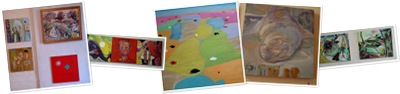
Adverse events propel Lindsay to remark on the unthinkable. In March 2006, journalist and Seaforth Highlander Lieut. Trevor Green, a former navy officer from Vancouver was assaulted with an axe to his head when attending a routine shuras, or meeting with Afghan village elders. ([2]) Lindsay depicted the ambush with a Munch-like visage, reminding the viewer of stunned meanderers in The Freeze of Life, only this impaled disembodied head (and subsequent version) drips blood: Hatchet. The quietude screams, brooding over the faith in communication, revealing a corporeal alarm.
New Arctic Landscape 1 and 11 are comprehensive investigations, addressing the ruin of our North. Sordid plunder shrouds the once pristine beauty, melting and evacuating wildness. Lindsay paints the understated rape with washes of paleness, memorializing past beauty. He shows us how our festering land scowls.
Trophy, versions 1, 11 and 111 utilize the deer symbol or abundance. Lindsay’s whimsy is at play here. A reclined head swallows the forefeet of the animal, a determination of our gluttony.
08-08-08 is elegant and striking. This is a one brush-stroke Zen painting, declaring how Lindsay’s contemplation and intuitive wisdom is at work in his art.
This exhibition displays Encryptomatons, seen at Open Space in ‘The Hidden is Hard to Come By’, a show with James Lindsay and David Gifford. This series of paintings references the 2003 atrocity when over 600 illegal combatants from the Afghanistan war were held in Guantanamo Bay, Cuba and the alleged genetic manipulations of prisoners in various wars. In his curatorial essay about Lindsay’s paintings, Roy Green wrote:
“These forms function as individual portraits of the genetically captured detainees, and appear as micro-cosmic slices of flesh exhumed from a Francis Bacon Painting, or perhaps digital cocoons, whirling bivalves of nano-technology gone horribly awry, floating in the dense blackness of metaphysical oil- meaning and identity encrypted within.”
“The dense blackness is analogous to the alchemist’s Nigredo state: the black that absorbs all colours, the vortex of silence releasing the dark night of the soul, the limitless void that holds these detainees in the deranged matrix of their digital cocoons.”
James Lindsay's work is monumental in its dauntless confrontation of his subjects, intrinsically painted. His show encompasses a life's work - 2 buildings and several floors. In this retrospective, Lindsay’s oeuvre is as intensely alluring as it is prophetic. Killer Paintings ensures we notice and gather insight. His compassionate portrayals are benevolently vengeful. Lindsay is our alerting guide through his deliberated, intuitive panoramas exposing the maliciousness that destroys where we live – environmentally profane and socio-politically saturated destruction. Killer Paintings is sagacious work; Lindsay refutes complacency. Lindsay augurs beyond transient, oneiric imagery. “An artist is a dreamer consenting to dream of the actual world.” ([3]) Literal and linear views will not sustain Lindsay’s significant descriptions. Thankfully, Lindsay presents a gift of stratified vision that layers time, showing diverse contexts. He shows us all, at once, so we do not forget to remember.
[1] Olwig, Kenneth. Landscape, nature, and the body politic: from Britain's renaissance to America's new world. Univ of Wisconsin Press, 2002
[2] http://www.cbc.ca/world/story/2006/03/04/canada-afghanistan060304.html#ixzz0uG92shYo
[3] George Santayana (Spanish born American Philosopher, Poet and 1863-1952)
James Lindsay “Killer Paintings“
17- 25 July 2010
Open Saturday & Sunday
Weekdays by appointment:
jameslindsayart@yahoo.ca
250.380.7687
549½ & 553½ Fisgard Street
Victoria BC
Sunday, June 27, 2010
Tracy Nelson: Walls of Intrigue and Cabinets of Curiosity & Alison Pebworth: Beautiful Possibility review by Debora Alanna
Beautiful Possibility
Alison Pebworth
Pebworth describes herself as a Neo- Pilgrim. She is a near-earth traveler on a specialized journey to seek, and to found, realize what is lost in America. Beautiful Possibility risks the integrity of picturesque models and theories. Painted on high-realism banners coalescing histories, Pebworth’s personal reconsideration of history’s time and place, interconnecting culture, recalibrates context with intricate whimsy. Complementing the banners, she maps her 2-year journey through points of her entry into narratives. These collected stories are cohesive passages routing and evaluating past and present communal, evolving markers.
The 19th century neurologist George M. Beard first defined what ails us, and called the condition Americanitis, resulting from “a fast way of life.” ([1]) Pebworth’s multiple, amalgamated concepts observe past and present Americanitis. Studying human culture and development, a comparative history of how time has advanced or evolved the pressures and distress that originally created the Americanitis condition, Pebworth devised a survey where participants can offer their contribution to this discussion. Collecting stories about lost or forgotten histories is also an integral dimension of this travelling show. Delighting in extraordinary opportunities for exploration, Pebworth’s itinerant exhibition gains content from interaction. Complete this survey on line, if you missed the Open Space form-filling opportunity.
Past travelling medicine shows peddled elixirs to ease pervasive anxiety, cure Americanitis. Pebworth created her own elixir to enable consideration of the cure. During a final performance, a drink of assorted leaves and blossom tea combined with vodka, poured into a communal oyster shell vessel provided a few with this elixir generating cautious examination of the possibility of transformation from this psychological panacea. Can there be a cure to what ails us? Do we really want a cure? Do we need a remedy? Pebworth’s excursion creates organized questioning.
This work is an evolving rendering, a portrait in the making, and the portrayal progresses with every thought and unearthing that incorporates the texture of past and present possibilities. Pebworth strives to beautify, to exemplify, circulating a surging need to restore our equilibrium, redirect our Americanitis towards the splendour of what is beautiful in our lives. This enquiring nomad promotes wellness and refreshing discovery of future possibilities. Her research into a Beautiful Possibility demonstrates this.
Beautiful Possibility tours the Northern United States after this only Southern Canada exposition. Video Pebworth’s next showcase is at the Missoula Public Library, 1 July – 10 July 2010. You can interact with the Beautiful Possibilityhttp://www.beautifulpossibilitytour.com/ through the website:
[1] http://www.beautifulpossibilitytour.com/
Walls of Intrigue and Cabinets of Curiosity
Tracy Nelson
Monkeys. Lots of sock-monkeys, monkeys made of recycled knitwear. Drawings of monkeys. Cabinets of mini-monkeys. Nelson has ardently made and mounted them all the way up the gallery walls, enlarged them to become freestanding primate-like sculptures and highlighted them in fabric wrapped consoles. Zealous projections, these monkeys silently taunt. Like Yasuma polka dots, Nelson’s crafted profusion saturates our vision, creating spectacle.
Disquieting creatures conspicuously seem to gaze at us, censorious, daunting. Gangly, elongated legs and arms, sometimes wrapping other little monkeys mainly dangle. Their frozen expressions frighten, toying with our willingness to think of this collection as entertaining. Nelson does portray some of her creatures humorously. There is playful contortion, diverting hats and funny features to examine. Yet the echoing stares redress the disturbance. Determined, modulated mania from the Walls of Intrigue directs us to the Cabinets of Curiosity. Fuzzy encased cabinetry pads the mechanism for framed vignettes of Nelson’s interacting creations. Monkey antics housed keeps the dynamics relegated, demonstrating nebulous inflections. Handmade, each monkey has integrity, and power to seize our wit.
A robot vacuum with spider-like legs holding pens, when active, obsessively draws on the floor. The critter monkeys. Here, there is a release of craze, a discharge of frantic inclinations.
In The Dancing Monkeys, Aesop describes the mimicking nature of nonhuman primates: “Being naturally great mimics of men's actions, they showed themselves most apt pupils, and when arrayed in their rich clothes and masks, they danced as well as any of the courtiers.”([1]) Nelson reverses the roles of monkey and audience, as does the clever story. We are observed; our actions are conspicuously a dance for attention. And as the monkeys in the fable scatter when the nuts are strewn for their consumption, we show our true natures when we are preoccupied with the nuttiness of obsessive acts. Nelson shows us that we are the intrigue, the curiosity. Video
[1] Aesop. Three Hundred and Fifty Aesop’s Fables. Trans. Rev. Geo. Flyer Townsend, M.A. Chicago: Belford, Clark & Co. 1882.
Alison Pebworth
Pebworth describes herself as a Neo- Pilgrim. She is a near-earth traveler on a specialized journey to seek, and to found, realize what is lost in America. Beautiful Possibility risks the integrity of picturesque models and theories. Painted on high-realism banners coalescing histories, Pebworth’s personal reconsideration of history’s time and place, interconnecting culture, recalibrates context with intricate whimsy. Complementing the banners, she maps her 2-year journey through points of her entry into narratives. These collected stories are cohesive passages routing and evaluating past and present communal, evolving markers.

The 19th century neurologist George M. Beard first defined what ails us, and called the condition Americanitis, resulting from “a fast way of life.” ([1]) Pebworth’s multiple, amalgamated concepts observe past and present Americanitis. Studying human culture and development, a comparative history of how time has advanced or evolved the pressures and distress that originally created the Americanitis condition, Pebworth devised a survey where participants can offer their contribution to this discussion. Collecting stories about lost or forgotten histories is also an integral dimension of this travelling show. Delighting in extraordinary opportunities for exploration, Pebworth’s itinerant exhibition gains content from interaction. Complete this survey on line, if you missed the Open Space form-filling opportunity.
Past travelling medicine shows peddled elixirs to ease pervasive anxiety, cure Americanitis. Pebworth created her own elixir to enable consideration of the cure. During a final performance, a drink of assorted leaves and blossom tea combined with vodka, poured into a communal oyster shell vessel provided a few with this elixir generating cautious examination of the possibility of transformation from this psychological panacea. Can there be a cure to what ails us? Do we really want a cure? Do we need a remedy? Pebworth’s excursion creates organized questioning.
This work is an evolving rendering, a portrait in the making, and the portrayal progresses with every thought and unearthing that incorporates the texture of past and present possibilities. Pebworth strives to beautify, to exemplify, circulating a surging need to restore our equilibrium, redirect our Americanitis towards the splendour of what is beautiful in our lives. This enquiring nomad promotes wellness and refreshing discovery of future possibilities. Her research into a Beautiful Possibility demonstrates this.
Beautiful Possibility tours the Northern United States after this only Southern Canada exposition. Video Pebworth’s next showcase is at the Missoula Public Library, 1 July – 10 July 2010. You can interact with the Beautiful Possibilityhttp://www.beautifulpossibilitytour.com/ through the website:
[1] http://www.beautifulpossibilitytour.com/
Walls of Intrigue and Cabinets of Curiosity
Tracy Nelson
Monkeys. Lots of sock-monkeys, monkeys made of recycled knitwear. Drawings of monkeys. Cabinets of mini-monkeys. Nelson has ardently made and mounted them all the way up the gallery walls, enlarged them to become freestanding primate-like sculptures and highlighted them in fabric wrapped consoles. Zealous projections, these monkeys silently taunt. Like Yasuma polka dots, Nelson’s crafted profusion saturates our vision, creating spectacle.

Disquieting creatures conspicuously seem to gaze at us, censorious, daunting. Gangly, elongated legs and arms, sometimes wrapping other little monkeys mainly dangle. Their frozen expressions frighten, toying with our willingness to think of this collection as entertaining. Nelson does portray some of her creatures humorously. There is playful contortion, diverting hats and funny features to examine. Yet the echoing stares redress the disturbance. Determined, modulated mania from the Walls of Intrigue directs us to the Cabinets of Curiosity. Fuzzy encased cabinetry pads the mechanism for framed vignettes of Nelson’s interacting creations. Monkey antics housed keeps the dynamics relegated, demonstrating nebulous inflections. Handmade, each monkey has integrity, and power to seize our wit.
A robot vacuum with spider-like legs holding pens, when active, obsessively draws on the floor. The critter monkeys. Here, there is a release of craze, a discharge of frantic inclinations.
In The Dancing Monkeys, Aesop describes the mimicking nature of nonhuman primates: “Being naturally great mimics of men's actions, they showed themselves most apt pupils, and when arrayed in their rich clothes and masks, they danced as well as any of the courtiers.”([1]) Nelson reverses the roles of monkey and audience, as does the clever story. We are observed; our actions are conspicuously a dance for attention. And as the monkeys in the fable scatter when the nuts are strewn for their consumption, we show our true natures when we are preoccupied with the nuttiness of obsessive acts. Nelson shows us that we are the intrigue, the curiosity. Video
[1] Aesop. Three Hundred and Fifty Aesop’s Fables. Trans. Rev. Geo. Flyer Townsend, M.A. Chicago: Belford, Clark & Co. 1882.
Sunday, June 20, 2010
Megan Dickie “Contact Games” review by Debora Alanna
Let’s play! The novelty of Contact Games jiggles and sways with the interaction between entity and participants that boing and shift, grapple and manoeuvre Megan Dickie’s palpable sculptures. A dynamic modification of our discernment about object and material changes with each play we engage.

 The Tangler , an ostensibly ponderous leather net encapsulated inflation, liberates amazement when it refreshes its position after a press in the opposite direction, wrestling with balance and upright positioning. The work invites with cajoling coax to reposition, to realign and shuffle our viewpoint. This enlarged embodiment abstractly portrays a field of vision, which topples quietly and reconfigures, with ballast that keeps the leather-fringed apex on top, a system of controlled interaction. Challenging reason with diversion, the absurdity of interchange tangles our sensibilities.
 Poised on a low pedestal, The Jiggler, a large sphere of conjoined leather strips, interiors sheathed with flexible aluminum, sits waiting for play. On the nearby wall, Dickie lists interaction suggestions: Gentle, Push, Rock, Jiggle. With an advisory outcome to this interplay, ‘it will grapple you’ posted below the play suggestions we confront a choice to seize, clasp and wrestle with the sculpture to produce an circumspect tussle of what wobbles our contrived notions of novelty. “It is that willing suspension of disbelief for the moment which constitutes poetic faith.” (1)
 Printed wall works present silkscreened images of rebel Dickie clothed to party, wearing Mexican Luchador wrestling masks (mascaras) that signifying the identity of the wrestler, allowing the characterization of god, hero or archetype, and designating the fight as kayfabe or real. Convincing interplay reflects Roland Barthes interpreting signs described in his essay, World of Wrestling, prefaced by a quote from Baudelaire,” The grandiloquent truth of gestures on life's great occasions.” Dickie’s work develops excessive gesturing contingent on game playing, while moderating the certainty of these signals.
 The Amazing Tangler presents two versions of the party-garbed dissenter in opposition to an unwieldy mass that references The Tangler. Prone, one incumbent lies arms outstretched endeavouring to envelope her opponent. This overlay impossibility is absurd, prohibitive because of the disparity between opponent’s largess and the diminutive size of the wrestler. Here, the defeat is Barthe’s “exaggeratedly visible explanation of a Necessity.”(2)Meanwhile, another subversive struggles to connect with this interweave, showing a different attack, strategy to contest the tangle. Dickie shows brave bravado despite inaccessibility, where the game’s fighter “...emphasizes and holds like a pause in music...” (3)
 The Contact Games triptych exercises similar, opposing contestants wresting forcibly with an insurmountable opponent. Intangible abandon overloads the interplay. Grappling with the claim of a game, an amusement, this serious match of will and seizing marks contact without the possibility of submission or defeat. The rollicking sport dwells in Dickie’s sculpture.
[1] Coleridge, Samuel Taylor. Biographia Literaria, 1817
[2] Barthes, Roland. Mythologies. Trans. Annette Lavers, Hill and Wang, New York, 1984.
[3] Barthes, Roland. Mythologies. Trans. Annette Lavers, Hill and Wang, New York, 1984.
Megan Dickie
Contact Games
11 June to 10 July 2010
Deluge Contemporary Art
636 Yates Street
Victoria BC Video

 The Tangler , an ostensibly ponderous leather net encapsulated inflation, liberates amazement when it refreshes its position after a press in the opposite direction, wrestling with balance and upright positioning. The work invites with cajoling coax to reposition, to realign and shuffle our viewpoint. This enlarged embodiment abstractly portrays a field of vision, which topples quietly and reconfigures, with ballast that keeps the leather-fringed apex on top, a system of controlled interaction. Challenging reason with diversion, the absurdity of interchange tangles our sensibilities.
 Poised on a low pedestal, The Jiggler, a large sphere of conjoined leather strips, interiors sheathed with flexible aluminum, sits waiting for play. On the nearby wall, Dickie lists interaction suggestions: Gentle, Push, Rock, Jiggle. With an advisory outcome to this interplay, ‘it will grapple you’ posted below the play suggestions we confront a choice to seize, clasp and wrestle with the sculpture to produce an circumspect tussle of what wobbles our contrived notions of novelty. “It is that willing suspension of disbelief for the moment which constitutes poetic faith.” (1)
 Printed wall works present silkscreened images of rebel Dickie clothed to party, wearing Mexican Luchador wrestling masks (mascaras) that signifying the identity of the wrestler, allowing the characterization of god, hero or archetype, and designating the fight as kayfabe or real. Convincing interplay reflects Roland Barthes interpreting signs described in his essay, World of Wrestling, prefaced by a quote from Baudelaire,” The grandiloquent truth of gestures on life's great occasions.” Dickie’s work develops excessive gesturing contingent on game playing, while moderating the certainty of these signals.
  The Amazing Tangler presents two versions of the party-garbed dissenter in opposition to an unwieldy mass that references The Tangler. Prone, one incumbent lies arms outstretched endeavouring to envelope her opponent. This overlay impossibility is absurd, prohibitive because of the disparity between opponent’s largess and the diminutive size of the wrestler. Here, the defeat is Barthe’s “exaggeratedly visible explanation of a Necessity.”(2)Meanwhile, another subversive struggles to connect with this interweave, showing a different attack, strategy to contest the tangle. Dickie shows brave bravado despite inaccessibility, where the game’s fighter “...emphasizes and holds like a pause in music...” (3)
 The Contact Games triptych exercises similar, opposing contestants wresting forcibly with an insurmountable opponent. Intangible abandon overloads the interplay. Grappling with the claim of a game, an amusement, this serious match of will and seizing marks contact without the possibility of submission or defeat. The rollicking sport dwells in Dickie’s sculpture.
 [1] Coleridge, Samuel Taylor. Biographia Literaria, 1817
[2] Barthes, Roland. Mythologies. Trans. Annette Lavers, Hill and Wang, New York, 1984.
[3] Barthes, Roland. Mythologies. Trans. Annette Lavers, Hill and Wang, New York, 1984.
Megan Dickie
Contact Games
11 June to 10 July 2010
Deluge Contemporary Art
636 Yates Street
Victoria BC Video
Sunday, June 13, 2010
Frank Torng “HerShe” Reviewed by Debora Alanna
Picture windows into a club life, Frank Torng’s HerShe is an aperture into the Drag Queen and Go-Go Boy emotional response of this rerouting world. Intimate portraits as overtures to compelling extravagance, candid or impromptu enactment offers us a study into this “third gender” and performance experience. Torng captures ritual dress and dressing, creating memories, memorials to his backstage family that shares dazzling goals and values.
Understanding this familial intimacy, Torng tightly composes his pictures. His photography resonate defining interplays of colour that expose this reality with deliberate articulation. Torng’s access to pre and post theatrical activity, association with characterizations created from behind the scenes creates work without fear of reprisal or need to conceal his observations. He produces refreshing candour. The reverie and admiration for his focus heightens our enthusiasm for his subjects. Torng’s exacting photographs are unadulterated portrayals within this segment of gay culture, bringing reliable documentation into view.
Torng, as an invited guest since boyhood, provides a fond record of spectacular events. Rather than peeking or peering through his lens, his convivial interchange protrudes throughout HerShe. The performers’ costumed facades become extroverted wonder through Torng faithful displays. Here, there is a Nan Goldin and Cindy Sherman influence. However, Torng does not detonate with the Goldin ribald impertinence or execute a Sherman staging. Torng salutes the ClubKids genre, related to the infamous Michael Alig, however, HerShe demonstrates intrinsic respect for these performers. Portraits exude sexuality, saturated with consideration.
As an emerging artist that eclipses perfunctory societal bias through his humanity, Frank Torng has obtained formal recognition by winning the University of Victoria BMO 1st Art Award, 2010 and has been shortlisted for the Future Generation Art Prize (results pending). Torng’s work quietly punctuates desires with acquisitive expertise.
Fifty Fifty Arts Collective 2516 Douglas St. Victoria, BC
3 June – 24 June 2010 Video
Understanding this familial intimacy, Torng tightly composes his pictures. His photography resonate defining interplays of colour that expose this reality with deliberate articulation. Torng’s access to pre and post theatrical activity, association with characterizations created from behind the scenes creates work without fear of reprisal or need to conceal his observations. He produces refreshing candour. The reverie and admiration for his focus heightens our enthusiasm for his subjects. Torng’s exacting photographs are unadulterated portrayals within this segment of gay culture, bringing reliable documentation into view.
Torng, as an invited guest since boyhood, provides a fond record of spectacular events. Rather than peeking or peering through his lens, his convivial interchange protrudes throughout HerShe. The performers’ costumed facades become extroverted wonder through Torng faithful displays. Here, there is a Nan Goldin and Cindy Sherman influence. However, Torng does not detonate with the Goldin ribald impertinence or execute a Sherman staging. Torng salutes the ClubKids genre, related to the infamous Michael Alig, however, HerShe demonstrates intrinsic respect for these performers. Portraits exude sexuality, saturated with consideration.
As an emerging artist that eclipses perfunctory societal bias through his humanity, Frank Torng has obtained formal recognition by winning the University of Victoria BMO 1st Art Award, 2010 and has been shortlisted for the Future Generation Art Prize (results pending). Torng’s work quietly punctuates desires with acquisitive expertise.
Fifty Fifty Arts Collective 2516 Douglas St. Victoria, BC
3 June – 24 June 2010 Video
Sunday, May 30, 2010
Rande Cook and Arlene Nesbitt by Debora Alanna
Innovative Visions of the Formline
Rande Cook
Works on paper and drum
13 May – 9 June 2010
Alcheringa Gallery
665 Fort St, Victoria BC
Rande Cook displays pride in his Kwakwaka’wakw heritage. A legacy of this First Nation’s tradition is the oral chronicles shared between its people. Visual depictions of stories, events and evocations embody art works. Impressions within oral histories befit specific, significant forms. Integral to this visual culture is the illustration of energy as Formline. Formline is not the outline of ovoids, circles and U form shapes that permeate the fundamental workings of this tradition; it is the coloured contour within the outline. Asserting the power and force found in living things, Formline tells stories, fortifies narratives with established shaping and colour.
Studying Formline as it transforms through time, and bringing his own interpretation of this evolution to his artwork, Cook presents more than a diachronic development. His innovative approach to Formline articulates and expands the historical application while respecting the Kwakwaka’wakw origins to this process. Sequentially, each work advances traditional design with crafted boldness.
Mapping sensation and reflection dominates Cook’s paintings. He develops intuitive terrain and elevates the sensibility of each idea he surveys. Taking Flight initiates the challenge to Formline with gentle colouration and graceful stretching. Supernatural amplifies that challenge, widening the central circle, releasing the restraint of visual modality from customary containment. Emerging heightens the feeling of possibility. A spacial incision releases the flow of energy, allowing burgeoning growth. Yellow ochre is the colour of healing, according to Cook. U forms, held by symbolic healing power enables the emergence of a new force. Bringing Light shows further release of Formline, with a lightening of palate and acknowledgement of presence, a disembodied spirit. In Play is mischievous teasing of Formline, testing and taunting the picture plane. Cook reveals introspection in Perception/Projection. Balancing elements are contrapuntal investigations. Painting a North West Coast traditional face, depicting the
recognizable nostrils and eye features, he continues to explore his challenges to Formline while confronting himself. Summer (drum), a circular painting on a drum is an explosive resonance, releasing Formline sensibility. A female figure, embedded in the reverberation of colour and abstracted Formline portrays in a contemporary stance. Elegance combines Formline and Cooks unique development. With a modish woman holding a wine glass, traditional structuring whirls and roots this work. Kwakwaka’wakw imagery tempers modern abandon.
More than half a century ago, First Nations artists were considering the importance of maintaining cultural integrity while developing new art practises. ” In 1948, (George) Clutesi claimed his art practice as a platform for ensuring that the old would not be totally sublimated to the new. He expressed his belief that “as long as paint exists on canvas, [my people’s] dances and legends will not be lost.[1]”[2] Through Rande Cook’s distinctive contribution to the enduring Kwakwaka’wakw culture, he advocates and advances his ethnic longevity, fearlessly contributing to its cultural vision.
[1] Crosby, Marcia. Making Indian Art Modern. Vancouver, BC: Ruins in Process. Morris and Helen Belkin Art Gallery. http://www.vancouverartinthesixties.com/
[2] Native Voice, September 1948, 3.
Image Informed
Arlene Nesbitt
Photomontage and digitally mixed media
21 May – 4 June 2010
Collective Works Gallery
1311 Gladstone Ave, Victoria BC
Arlene Nesbitt’s work is awakening. Her sumptuous prints line the Collective Works walls, toying and tugging at what is present in our senses. Drawings on various surfaces superimpose photographs, expertly layered. Each work evokes an intense revelation.
Paul Trejo’s 1993 analysis of Hegel’s Phenomenology of Mind (alias Phenomenology of Spirit) [1] explains that Hegel used phenomenon to consider appearance. “... we can only know Reality when we have completely mastered the appearances, since the appearances (phenomena) partially hide and partially reveal Reality... and there can be degrees of truth in propositions.” “Phenomena of mind also partially hide and partially reveal the truth.”
Nesbitt has employed this understanding of Phenomenology in her work. Crumpled aluminum becomes phenomenon (Invocation, Tracks). There is a transportation of our senses, a marvellous transmutation from the reality of metal, of industry and its connotations of impairment. These works transfigure material existence it plays with our understanding of the truth of the object. Crushed rose petals become a metallic ballet. (Dancer 1 and Dancer 11)
Recalling Marshall McLuhan, Derick de Kerchove said: “... he was constantly discovering, as if feeling the shapes of knowledge with his hands. ...thinking not with his head but with all his senses... did not deduce things... he perceived directly...” [2] Here, there is a correspondence to Nesbitt’s working process. Through works like Hybrid 1 and Hybrid 11, machinations layer the sensation of circulating discovery. Strokes of crayon or droplets on Mylar over industrial histories inculcate living memory through her sensual processing. Nesbitt’s direct perceptions communicate visual acuity.
In works such as Out of Kilter and Fence, Nesbitt employs nature, supplanting awe with consideration. We struggle to see foliage; she obfuscates the view with pattern and structure. Superimposed, coloured touches transfer complication to our preconceptions. We encounter a hermetic restlessness, a withdrawal to ruminate, to introspect. We recognize this need, and her work has brought us to the hermitage.
Nesbit considers the disposition of bones and teeth in Bones, a triptych. Her powerful presage to mortality directs our emotional enlightening, applying gentility to our fear. We become receptive to Nesbitt’s wilful surface light stirring our biases. Genuine, Nesbitt’s work touches us because this suggestion of our physical world allows us belief. Beauty hovers, suggesting physicality, which alludes to our vulnerability, a rumpled idea. Meeting is a playful portraiture. Nesbitt soaks colour, enlivens the surface, composing a current that radiates around the intimation of two figures. A portent, the radiance inundates, and reciprocity is phenomenon. video
[1] Trejo, Paul. Summary of Hegel’s Philosophy of Mind, 1993. http://philosophy.eserver.org/hegel-summary.html
[2] de Kerckhove, Derrick. Zulu Time (orig. L'heure zulu), 1999 NFC documentary, director Jonny Silver
Rande Cook
Works on paper and drum
13 May – 9 June 2010
Alcheringa Gallery
665 Fort St, Victoria BC

Rande Cook displays pride in his Kwakwaka’wakw heritage. A legacy of this First Nation’s tradition is the oral chronicles shared between its people. Visual depictions of stories, events and evocations embody art works. Impressions within oral histories befit specific, significant forms. Integral to this visual culture is the illustration of energy as Formline. Formline is not the outline of ovoids, circles and U form shapes that permeate the fundamental workings of this tradition; it is the coloured contour within the outline. Asserting the power and force found in living things, Formline tells stories, fortifies narratives with established shaping and colour.
Studying Formline as it transforms through time, and bringing his own interpretation of this evolution to his artwork, Cook presents more than a diachronic development. His innovative approach to Formline articulates and expands the historical application while respecting the Kwakwaka’wakw origins to this process. Sequentially, each work advances traditional design with crafted boldness.
Mapping sensation and reflection dominates Cook’s paintings. He develops intuitive terrain and elevates the sensibility of each idea he surveys. Taking Flight initiates the challenge to Formline with gentle colouration and graceful stretching. Supernatural amplifies that challenge, widening the central circle, releasing the restraint of visual modality from customary containment. Emerging heightens the feeling of possibility. A spacial incision releases the flow of energy, allowing burgeoning growth. Yellow ochre is the colour of healing, according to Cook. U forms, held by symbolic healing power enables the emergence of a new force. Bringing Light shows further release of Formline, with a lightening of palate and acknowledgement of presence, a disembodied spirit. In Play is mischievous teasing of Formline, testing and taunting the picture plane. Cook reveals introspection in Perception/Projection. Balancing elements are contrapuntal investigations. Painting a North West Coast traditional face, depicting the
recognizable nostrils and eye features, he continues to explore his challenges to Formline while confronting himself. Summer (drum), a circular painting on a drum is an explosive resonance, releasing Formline sensibility. A female figure, embedded in the reverberation of colour and abstracted Formline portrays in a contemporary stance. Elegance combines Formline and Cooks unique development. With a modish woman holding a wine glass, traditional structuring whirls and roots this work. Kwakwaka’wakw imagery tempers modern abandon.
More than half a century ago, First Nations artists were considering the importance of maintaining cultural integrity while developing new art practises. ” In 1948, (George) Clutesi claimed his art practice as a platform for ensuring that the old would not be totally sublimated to the new. He expressed his belief that “as long as paint exists on canvas, [my people’s] dances and legends will not be lost.[1]”[2] Through Rande Cook’s distinctive contribution to the enduring Kwakwaka’wakw culture, he advocates and advances his ethnic longevity, fearlessly contributing to its cultural vision.
[1] Crosby, Marcia. Making Indian Art Modern. Vancouver, BC: Ruins in Process. Morris and Helen Belkin Art Gallery. http://www.vancouverartinthesixties.com/
[2] Native Voice, September 1948, 3.
Image Informed
Arlene Nesbitt
Photomontage and digitally mixed media
21 May – 4 June 2010
Collective Works Gallery
1311 Gladstone Ave, Victoria BC

Arlene Nesbitt’s work is awakening. Her sumptuous prints line the Collective Works walls, toying and tugging at what is present in our senses. Drawings on various surfaces superimpose photographs, expertly layered. Each work evokes an intense revelation.
Paul Trejo’s 1993 analysis of Hegel’s Phenomenology of Mind (alias Phenomenology of Spirit) [1] explains that Hegel used phenomenon to consider appearance. “... we can only know Reality when we have completely mastered the appearances, since the appearances (phenomena) partially hide and partially reveal Reality... and there can be degrees of truth in propositions.” “Phenomena of mind also partially hide and partially reveal the truth.”
Nesbitt has employed this understanding of Phenomenology in her work. Crumpled aluminum becomes phenomenon (Invocation, Tracks). There is a transportation of our senses, a marvellous transmutation from the reality of metal, of industry and its connotations of impairment. These works transfigure material existence it plays with our understanding of the truth of the object. Crushed rose petals become a metallic ballet. (Dancer 1 and Dancer 11)
Recalling Marshall McLuhan, Derick de Kerchove said: “... he was constantly discovering, as if feeling the shapes of knowledge with his hands. ...thinking not with his head but with all his senses... did not deduce things... he perceived directly...” [2] Here, there is a correspondence to Nesbitt’s working process. Through works like Hybrid 1 and Hybrid 11, machinations layer the sensation of circulating discovery. Strokes of crayon or droplets on Mylar over industrial histories inculcate living memory through her sensual processing. Nesbitt’s direct perceptions communicate visual acuity.
In works such as Out of Kilter and Fence, Nesbitt employs nature, supplanting awe with consideration. We struggle to see foliage; she obfuscates the view with pattern and structure. Superimposed, coloured touches transfer complication to our preconceptions. We encounter a hermetic restlessness, a withdrawal to ruminate, to introspect. We recognize this need, and her work has brought us to the hermitage.
Nesbit considers the disposition of bones and teeth in Bones, a triptych. Her powerful presage to mortality directs our emotional enlightening, applying gentility to our fear. We become receptive to Nesbitt’s wilful surface light stirring our biases. Genuine, Nesbitt’s work touches us because this suggestion of our physical world allows us belief. Beauty hovers, suggesting physicality, which alludes to our vulnerability, a rumpled idea. Meeting is a playful portraiture. Nesbitt soaks colour, enlivens the surface, composing a current that radiates around the intimation of two figures. A portent, the radiance inundates, and reciprocity is phenomenon. video
[1] Trejo, Paul. Summary of Hegel’s Philosophy of Mind, 1993. http://philosophy.eserver.org/hegel-summary.html
[2] de Kerckhove, Derrick. Zulu Time (orig. L'heure zulu), 1999 NFC documentary, director Jonny Silver
Saturday, May 22, 2010
Pedestrian Colour by Debora Alanna
Slide Room Gallery
Victoria, BC
May 7 - 28, 2010
Curator: John Luna
Artists: Sean Alward, Marlene Bouchard, Jonathan Dowdall, Alexander Grewal, June Higgins, Michael Jess, Paul La Farge, Nathan Paine, and Wendy Welch.
Fleeting information, transient objects we manipulate, exchange or briefly acquire and discard, short-lived experiences that permeate our lives needs context to describe, to understand. An opportunity to reflect on the barrage of material layering and consequences of that saturate is presented in the works of 9 discerning artists at the Slide Room gallery, through the Pedestrian ColourPedestrian Colour framework, each artist has a personal response to their environment; each uses public resources as materials for their constructs or imagery, availing perspicacity to our present society. Yet as a group gathered to develop the premise for this show, we are privy to a larger, generous view of our impatient culture.
Luna named this show after the Robert Rauschenberg’s term Pedestrian Color, describing interaction, absorption, independence and neutrality, [1] referring to how, on the street, obvious colour and form can articulate and unify, develop patina. Patina, as Luna advances in his curatorial essay, can be the evocation of significance. Throughout a pedestrian life, our seemingly facile encounters become poetic continuity. exhibition. The derivation and relationships to nullity these artists employ to produce work have a multifaceted import because of John Luna’s curatorial vision. Independent of the On rusted, rolling restaurant shelving, Alex Grewal displays a collection of abandoned signs earnestly requesting aid, beggars’ intractable markers. Confined to these shelves, the signs replace produce: needs not met. Objectified stubbornness resonates from the beggars’ signs, creating a “poetics of intransigency”, Luna clarifies. Grewal’s work assembles the conjecture of tarnished lives, a cultural patina.
 Marlene Bouchard presented bottled water, drawn from public sources. Overrun by pedestrian notions of singular consumption, Bouchard comments on the complacence of consumerism. Luna adds, “...working up of character into a culture of personality.”, which colours the outcome of our choices. Bouchard has also shows two coloured collages, one, spewing or devouring commercialized bits, literally and metaphorically to or from an hole of dark and dangerous gluttony, and a landscape where paths are torn bits of telephone directories, cows and doorways are sequestered by barbed wire, clouds are date stamped. All of Bouchard’s work luridly warns.
 The Roll Me series by Rob McTavish are tiny cubes that denote yielding, the chance to determine and protract interactivity. “[The cubes] can be for anyone. I want them to just kick them down the street you know?”, McTavish’s says. Luna reminds us of Leo Steinberg’s
  [1] We imagine street commotion resulting from the intermittent lightness of contact with cubes and pedestrians, creating a glaze of movement. Additionally, posted on the exit door are 6 black and white prints of McTavish poems, slightly concealed by the door brace. They are street posters, of slightly variable text, like architectural hording wallpaper shouting about agonizing violence: Close Eyes and you will see that colour. comment , “...the fruit of an artist’s work need not be an object. It could be an action...”
  Laird Hamilton lightens the risk inherent in 6/49 by exhibiting 2 lottery tickets with the same numbers, one drawn by chance, the other obtained with the same numbers by request. This work explicitly demonstrates corrosive societal longing. Fresh white gambling receipts, tickets representing the promise of value illustrate a patina of acerbic consequence. Luna tells us, “Swapping white for money is an old notion...”. He reminds us of Yves Klein selling bare white gallery space for gold leaf certificates that Klein later discarded in the River Seine. Gaming in any form is the promise of reward, the artless draw to experience the flush of a common dream. Hamilton succeeds to colour our feelings.
 We are the pedestrian voyeurs, looking into hidden spaces with Sean Alward’s pair of photos. Alward gives up peep holes, round mats, to see a long undisturbed space discovered during a renovation - ‘pseudo archaeology’, Alward describes. In the first photo, there is a disturbing confinement, an inaccessible aperture to the daunting unknown, the brick surround of a darks squared opening, accompanied by a scrap of colour-stained cloth that brings propinquity to the imagery . Secondly, we see the open floorboards, a gaping conceptual structure that we may inspect after a studio fire’s consumption that Alward has personalized with an encircling of white gauche spray. Unlike the view we may have passing a construction site, the intimacy of theses peeks reflect, as Luna eloquently says, “hidden pockets of willful ignorance and delayed gratification like fossilized matter awaiting exposure and combustion.”
 A sculptural work, Prom Night, is June Higgins’ contribution to Pedestrian Colour. A jaunty light fixture fills with remnants of getting ready for a prom, a balsa emulation of light sprays in open weave rays decorated with balloon lips. The light is perched on dominoes, presented on a flouncy platform. Higgins has provided a miniaturized explosion of festival, parading rosy memories of a customary rite of passage. Here, Pedestrian Colour interprets commonplace influences, a patina of vivid lives.
 A mesh of videotaped exteriors played in an alcove present walking scenarios of visual oddments, takes us on a sojourn of dazed existence. Michael Jess’s videos are titles ornen, reypeha, irithjiens, lstyn, made-up words that accompany distortion, intoxication of Eric Satie and John Cage, asking: “alter, not the means
 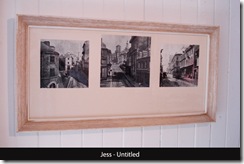 of connection, but the things being connected.” Jess’s second work displays 3 found exterior photos are garnished with cages of hand drawn geometry, and tinted to manipulate our vision. Through Jess, we visualize a hovering of imagined, imposing structure, superimposed on the pedestrian landscape, allowing us to see future probability.
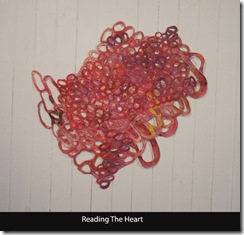 Wendy Welch’s Reading the Heart is a compressed wall work. Stitched newspapers construct a cross-section of red-saturated valves, or empty cells, holes cut and overlapped, multilayered inferences about of what is red, read and unread. Reducing communication or the heart of what matters expounds a everyday need, a regret, a hope for reconstructive treatment - the patina of a weathering soul.
 Paul La Farge contributes an essay to this show. [2] Luna obtained permission from Cabinet to include this writing as a thought-provoking component of Pedestrian Colour. Luna discusses Rauschenberg‘s ‘black-paintings’; they are physical responses, not metaphors. In this work, black is a means of revelation about ourselves. La Farge says, “Because we are capable of inaction, we know that we have the ability to act, and also the choice of whether to act or not.” Blackness as a colour or non-colour is a physical and metaphysical presence, and absence. Just as pedestrians, we interact or ignore. La Farge considers liminal space, where the threshold for human functioning or psychological response exists. As he explains, the blackness, the space of imagination is freedom. This is a daily preoccupation within our private and public reality.
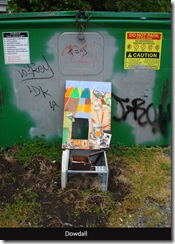 Easily missed, but decisively integral to the Pedestrian Colour premise is Jonathan Dowdall’s construction that leans against a disposal bin at the entrance to the Slide Room Gallery. There is lustre in this assemblage, a bright construct, a beacon that makes us look as we pass as pedestrians, giving colour to our day.
[1] Random Order: Robert Rauschenberg and the neo-avant-garde. “An October Book”. Massachusetts Institute of Technology Press, 2003. Joseph, Branden Wayne,
[1] Leo Steinberg, Encounters with Rauschenberg, (Chicago and London: University of Chicago Press, 2000), p. 22
[2] http://www.cabinetmagazine.org/issues/36/lafarge.php
Victoria, BC
May 7 - 28, 2010
Curator: John Luna
Artists: Sean Alward, Marlene Bouchard, Jonathan Dowdall, Alexander Grewal, June Higgins, Michael Jess, Paul La Farge, Nathan Paine, and Wendy Welch.
Fleeting information, transient objects we manipulate, exchange or briefly acquire and discard, short-lived experiences that permeate our lives needs context to describe, to understand. An opportunity to reflect on the barrage of material layering and consequences of that saturate is presented in the works of 9 discerning artists at the Slide Room gallery, through the Pedestrian ColourPedestrian Colour framework, each artist has a personal response to their environment; each uses public resources as materials for their constructs or imagery, availing perspicacity to our present society. Yet as a group gathered to develop the premise for this show, we are privy to a larger, generous view of our impatient culture.
Luna named this show after the Robert Rauschenberg’s term Pedestrian Color, describing interaction, absorption, independence and neutrality, [1] referring to how, on the street, obvious colour and form can articulate and unify, develop patina. Patina, as Luna advances in his curatorial essay, can be the evocation of significance. Throughout a pedestrian life, our seemingly facile encounters become poetic continuity. exhibition. The derivation and relationships to nullity these artists employ to produce work have a multifaceted import because of John Luna’s curatorial vision. Independent of the
 On rusted, rolling restaurant shelving, Alex Grewal displays a collection of abandoned signs earnestly requesting aid, beggars’ intractable markers. Confined to these shelves, the signs replace produce: needs not met. Objectified stubbornness resonates from the beggars’ signs, creating a “poetics of intransigency”, Luna clarifies. Grewal’s work assembles the conjecture of tarnished lives, a cultural patina.
 Marlene Bouchard presented bottled water, drawn from public sources. Overrun by pedestrian notions of singular consumption, Bouchard comments on the complacence of consumerism. Luna adds, “...working up of character into a culture of personality.”, which colours the outcome of our choices. Bouchard has also shows two coloured collages, one, spewing or devouring commercialized bits, literally and metaphorically to or from an hole of dark and dangerous gluttony, and a landscape where paths are torn bits of telephone directories, cows and doorways are sequestered by barbed wire, clouds are date stamped. All of Bouchard’s work luridly warns.
  The Roll Me series by Rob McTavish are tiny cubes that denote yielding, the chance to determine and protract interactivity. “[The cubes] can be for anyone. I want them to just kick them down the street you know?”, McTavish’s says. Luna reminds us of Leo Steinberg’s
  [1] We imagine street commotion resulting from the intermittent lightness of contact with cubes and pedestrians, creating a glaze of movement. Additionally, posted on the exit door are 6 black and white prints of McTavish poems, slightly concealed by the door brace. They are street posters, of slightly variable text, like architectural hording wallpaper shouting about agonizing violence: Close Eyes and you will see that colour. comment , “...the fruit of an artist’s work need not be an object. It could be an action...”
  Laird Hamilton lightens the risk inherent in 6/49 by exhibiting 2 lottery tickets with the same numbers, one drawn by chance, the other obtained with the same numbers by request. This work explicitly demonstrates corrosive societal longing. Fresh white gambling receipts, tickets representing the promise of value illustrate a patina of acerbic consequence. Luna tells us, “Swapping white for money is an old notion...”. He reminds us of Yves Klein selling bare white gallery space for gold leaf certificates that Klein later discarded in the River Seine. Gaming in any form is the promise of reward, the artless draw to experience the flush of a common dream. Hamilton succeeds to colour our feelings.
  We are the pedestrian voyeurs, looking into hidden spaces with Sean Alward’s pair of photos. Alward gives up peep holes, round mats, to see a long undisturbed space discovered during a renovation - ‘pseudo archaeology’, Alward describes. In the first photo, there is a disturbing confinement, an inaccessible aperture to the daunting unknown, the brick surround of a darks squared opening, accompanied by a scrap of colour-stained cloth that brings propinquity to the imagery . Secondly, we see the open floorboards, a gaping conceptual structure that we may inspect after a studio fire’s consumption that Alward has personalized with an encircling of white gauche spray. Unlike the view we may have passing a construction site, the intimacy of theses peeks reflect, as Luna eloquently says, “hidden pockets of willful ignorance and delayed gratification like fossilized matter awaiting exposure and combustion.”
 A sculptural work, Prom Night, is June Higgins’ contribution to Pedestrian Colour. A jaunty light fixture fills with remnants of getting ready for a prom, a balsa emulation of light sprays in open weave rays decorated with balloon lips. The light is perched on dominoes, presented on a flouncy platform. Higgins has provided a miniaturized explosion of festival, parading rosy memories of a customary rite of passage. Here, Pedestrian Colour interprets commonplace influences, a patina of vivid lives.
 A mesh of videotaped exteriors played in an alcove present walking scenarios of visual oddments, takes us on a sojourn of dazed existence. Michael Jess’s videos are titles ornen, reypeha, irithjiens, lstyn, made-up words that accompany distortion, intoxication of Eric Satie and John Cage, asking: “alter, not the means
  of connection, but the things being connected.” Jess’s second work displays 3 found exterior photos are garnished with cages of hand drawn geometry, and tinted to manipulate our vision. Through Jess, we visualize a hovering of imagined, imposing structure, superimposed on the pedestrian landscape, allowing us to see future probability.
  Wendy Welch’s Reading the Heart is a compressed wall work. Stitched newspapers construct a cross-section of red-saturated valves, or empty cells, holes cut and overlapped, multilayered inferences about of what is red, read and unread. Reducing communication or the heart of what matters expounds a everyday need, a regret, a hope for reconstructive treatment - the patina of a weathering soul.
  Paul La Farge contributes an essay to this show. [2] Luna obtained permission from Cabinet to include this writing as a thought-provoking component of Pedestrian Colour. Luna discusses Rauschenberg‘s ‘black-paintings’; they are physical responses, not metaphors. In this work, black is a means of revelation about ourselves. La Farge says, “Because we are capable of inaction, we know that we have the ability to act, and also the choice of whether to act or not.” Blackness as a colour or non-colour is a physical and metaphysical presence, and absence. Just as pedestrians, we interact or ignore. La Farge considers liminal space, where the threshold for human functioning or psychological response exists. As he explains, the blackness, the space of imagination is freedom. This is a daily preoccupation within our private and public reality.
 Easily missed, but decisively integral to the Pedestrian Colour premise is Jonathan Dowdall’s construction that leans against a disposal bin at the entrance to the Slide Room Gallery. There is lustre in this assemblage, a bright construct, a beacon that makes us look as we pass as pedestrians, giving colour to our day.
 [1] Random Order: Robert Rauschenberg and the neo-avant-garde. “An October Book”. Massachusetts Institute of Technology Press, 2003. Joseph, Branden Wayne,
[1] Leo Steinberg, Encounters with Rauschenberg, (Chicago and London: University of Chicago Press, 2000), p. 22
[2] http://www.cabinetmagazine.org/issues/36/lafarge.php
Saturday, May 15, 2010
Jason Grondin – The Infinitely Dense Atom Experiment by Debora Alanna
7 May – 20 May 2010 -Collective Works Gallery -Victoria BC
In Leonardo, MITs art and technology publication, Ellen K. Levy reviewed last October’s 43rd International Association of Art Critics (AICA) Congress - The Relations between Art and Science: Complicity, Criticality, Knowledge. Levy references Susan Sulic’s discussion about how Lucio Fontana’s (1899 – 1968) early work initiated the artistic examination of (outer) space.[1] Space and time, science theory and investigations are permanently in artists’ domain. Jason Grondin contributes to this continuing dialogue.
Grondin’s experiential paintings are a visceral synthesis of hypothetical concepts. Visually expansive, the work exemplifies interconnectivity. After considering scientific theory, such as the “Big Bang”, (a hypothesis proposed by Georges Lemaître and phrase coined and idea refuted by Sir Fredrick Hoyle, both astronomers) he gesturally processes this inception of the universe with lively, curvaceous lines and abstracted connotations of particles. Grondin reaches beyond scientific assessments of formation from infinitely dense atoms. We see a belief in beauty, ordered chaos and an enchanting orchestration of wonder.
Initially inspired by Kandinsky, we can see Grondin’s homage to that explosive, spacial appreciation and discovery. However, there is a buoyant responsiveness in this work. Grondin’s palate is mostly soft and transient, and shapes articulate with few hard edges. We can see Klee-like bounce of calligraphic capture and Miro inspired exuberance that this artist translates to his own graphic dance. Using these techniques to forge the excitement of generation, Grondin deflects his thoughts to the outcomes of scientific abuse in Atomic Child. The raw wood panels of two works acknowledge our earth underneath the hovering reminder of atomic beginnings and future apocalyptic possibilities of our future. The dark washes of Reconstruction of Chaos and Through the Ashes deflect the viewer towards the inevitable murkiness between beginnings and definition. Grondin’s demonstrative enthusiasm for cosmic expansion resonates in Spontaneous Generation, and pairing the similar work, Rise and Fall instructs us that he is aware of the dichotomy of substance, how wave and particle matter, or any significance behaves differently under varied conditions. The painterly impasto backgrounds of four images signify jaunty heavens speedily layering under continued genesis. Grondin’s work postulates that the inception of the infinite universe is contingent on a feisty inaugural release within enigmatic space. We are witness to the integrity of this embracing assurance. Video
[1] http://www.leonardo.info/reviews/dec2009/xliiirdaica.levy.php
video
In Leonardo, MITs art and technology publication, Ellen K. Levy reviewed last October’s 43rd International Association of Art Critics (AICA) Congress - The Relations between Art and Science: Complicity, Criticality, Knowledge. Levy references Susan Sulic’s discussion about how Lucio Fontana’s (1899 – 1968) early work initiated the artistic examination of (outer) space.[1] Space and time, science theory and investigations are permanently in artists’ domain. Jason Grondin contributes to this continuing dialogue.

Grondin’s experiential paintings are a visceral synthesis of hypothetical concepts. Visually expansive, the work exemplifies interconnectivity. After considering scientific theory, such as the “Big Bang”, (a hypothesis proposed by Georges Lemaître and phrase coined and idea refuted by Sir Fredrick Hoyle, both astronomers) he gesturally processes this inception of the universe with lively, curvaceous lines and abstracted connotations of particles. Grondin reaches beyond scientific assessments of formation from infinitely dense atoms. We see a belief in beauty, ordered chaos and an enchanting orchestration of wonder.
Initially inspired by Kandinsky, we can see Grondin’s homage to that explosive, spacial appreciation and discovery. However, there is a buoyant responsiveness in this work. Grondin’s palate is mostly soft and transient, and shapes articulate with few hard edges. We can see Klee-like bounce of calligraphic capture and Miro inspired exuberance that this artist translates to his own graphic dance. Using these techniques to forge the excitement of generation, Grondin deflects his thoughts to the outcomes of scientific abuse in Atomic Child. The raw wood panels of two works acknowledge our earth underneath the hovering reminder of atomic beginnings and future apocalyptic possibilities of our future. The dark washes of Reconstruction of Chaos and Through the Ashes deflect the viewer towards the inevitable murkiness between beginnings and definition. Grondin’s demonstrative enthusiasm for cosmic expansion resonates in Spontaneous Generation, and pairing the similar work, Rise and Fall instructs us that he is aware of the dichotomy of substance, how wave and particle matter, or any significance behaves differently under varied conditions. The painterly impasto backgrounds of four images signify jaunty heavens speedily layering under continued genesis. Grondin’s work postulates that the inception of the infinite universe is contingent on a feisty inaugural release within enigmatic space. We are witness to the integrity of this embracing assurance. Video
[1] http://www.leonardo.info/reviews/dec2009/xliiirdaica.levy.php
video
Sunday, May 9, 2010
James Gordaneer: "A Life in Painting" -by Debora Alanna
Art Gallery of Greater Victoria
9 April - 6 June 2010
Jim Gordaneer teaches us bravery. His innate ability to dwell on his passion conspicuously drives and inspires his continued investigations. Mettlesome, Gordaneer distinctively scrutinizes plenty of genres over the decades of his production and produces unique paintings throughout the barrage of influences. Samples of his paintings on show at the AGGV are glimpses into a lifetime of accomplished dialogue embodied in canvas and board. Serious introspection presents through experimental abstraction jostling figurative reflection and using colour palates pertinent to various decades of approach. Prosaic subjects of comedic banality endear us to this work.
We are privy to Gordaneer’s droll commentary and understated constructs that unpretentiously probe flattening Modernism through his ’60 and ‘70s paintings. Puzzles of painterly parts stabilize delineated surfaces. He recalls the emotional conspiracy of Bacon’s smears and the Synthetic Cubist abandon of Gorky, indicating homage while gathering a personal, diverting vocabulary of style.
Gordaneer grumpily imposes a transfer of colour field doctrine with greyed palates and dismayed regard in the structured figures of Hortense (1985) and Rufus (1986). Waitress ll (1984) and Circus Series: Black Wire (1985) are shifts in his consternation, with cerulean optimism outweighing staidly chairs and playful deranging of pink and orange figures that revive Gordaneer’s recurring circus theme, enlivening his love of figuration. Gordaneer incarcerates this Post- Painterly Abstraction discipline through Beacon Hill Series: Band Stand (1987).
Paintings based on undulating philosophical conversations with Raymond Lorens, domineer Licence, The Harpist and Bass Player and Violinist (1993). Gordaneer’s topological figures twist and stretch, harmonizing coloured stripes or synchronize waves of geometry. Here, there is a revival of pure colour and brash figuration that earnestly discards the presumptive wake of art history’s duress. The drama of this work stages a mind-shift for Gordaneer.
Subsequent paintings rearrange his painted vocabulary, embracing neoexpressionist sensibilities, liberating the figures from outlines in favour of multi-layered constructs. Gordaneer’s results are confident and mischievous. He teases and invigorates the images of Sailor and The Umpire (2005), charging the delivery with belief.
The 2009 paintings have changed perspective. Looking down on an assemblage of body parts and excited elements of abstracted forms, Gordaneer punctuates the work with thriving, sophisticated idea proclamation. Gordaneer dares to confront a life of learning and transports his understanding to synergized observations, with sketches and ultimately master works. Rising above past ideology, he raises his investigative intensity and allows his imagination to ascend.
9 April - 6 June 2010
Jim Gordaneer teaches us bravery. His innate ability to dwell on his passion conspicuously drives and inspires his continued investigations. Mettlesome, Gordaneer distinctively scrutinizes plenty of genres over the decades of his production and produces unique paintings throughout the barrage of influences. Samples of his paintings on show at the AGGV are glimpses into a lifetime of accomplished dialogue embodied in canvas and board. Serious introspection presents through experimental abstraction jostling figurative reflection and using colour palates pertinent to various decades of approach. Prosaic subjects of comedic banality endear us to this work.
We are privy to Gordaneer’s droll commentary and understated constructs that unpretentiously probe flattening Modernism through his ’60 and ‘70s paintings. Puzzles of painterly parts stabilize delineated surfaces. He recalls the emotional conspiracy of Bacon’s smears and the Synthetic Cubist abandon of Gorky, indicating homage while gathering a personal, diverting vocabulary of style.
Gordaneer grumpily imposes a transfer of colour field doctrine with greyed palates and dismayed regard in the structured figures of Hortense (1985) and Rufus (1986). Waitress ll (1984) and Circus Series: Black Wire (1985) are shifts in his consternation, with cerulean optimism outweighing staidly chairs and playful deranging of pink and orange figures that revive Gordaneer’s recurring circus theme, enlivening his love of figuration. Gordaneer incarcerates this Post- Painterly Abstraction discipline through Beacon Hill Series: Band Stand (1987).
Paintings based on undulating philosophical conversations with Raymond Lorens, domineer Licence, The Harpist and Bass Player and Violinist (1993). Gordaneer’s topological figures twist and stretch, harmonizing coloured stripes or synchronize waves of geometry. Here, there is a revival of pure colour and brash figuration that earnestly discards the presumptive wake of art history’s duress. The drama of this work stages a mind-shift for Gordaneer.
Subsequent paintings rearrange his painted vocabulary, embracing neoexpressionist sensibilities, liberating the figures from outlines in favour of multi-layered constructs. Gordaneer’s results are confident and mischievous. He teases and invigorates the images of Sailor and The Umpire (2005), charging the delivery with belief.
The 2009 paintings have changed perspective. Looking down on an assemblage of body parts and excited elements of abstracted forms, Gordaneer punctuates the work with thriving, sophisticated idea proclamation. Gordaneer dares to confront a life of learning and transports his understanding to synergized observations, with sketches and ultimately master works. Rising above past ideology, he raises his investigative intensity and allows his imagination to ascend.

Friday, April 30, 2010
Ira Hoffecker by Debora Alanna
Urban Settings
Dales Gallery
8 April – 4 May 2010
Ira Hoffecker structures perception. She describes the correspondence between architectural reference and historical elements with expansive plotting, Commuting angular shapes to ideas, Hoffecker incorporates the filtration of deep reflection into her canvases. She bolsters her visions with complex stimulation, considering artists like Nicolas de Stael, Robert Motherwell, Hans Hofmann and Robert Rauschenberg. Her unique discernment references that abstractionist vocabulary, while instilling a fresh spaciousness into her work.
Imprints of metal forms encourage an industrial orientation within the canvas plane that builds the agenda for the work. Features, such as text swatches and print transfers delineate the topography of her paintings like fleeting, cherished memories. Drips punctuate with calculated incursion. The visual acuity of some work is cultivated by raising canvas levels, incorporating metal remnants on or under the surface and scraping or sanding paint away to reveal pigment levels, sharing a significant depth of past proceedings.
Hoffecker’s canvases are sometimes raw and stained with squared apertures, hues inviting introspection. They comfortably interrelate cooperatively, with gestural line drawings that dance amongst the calculated balance. Some surfaces are impressed with resin, high gloss lustre that holds the saturated colour strokes, reflecting back to the viewer. She mirrors recollections that exude tenacity. Here, the integrated compositions of abstracted form and materials of cosmopolitan life are a presence that shines fearlessly.
Through Urban Settings, we witness Hoffecker’s visualization of urban life that compels us to relinquish literal identification of city existence for a sincere, intangible understanding of the metropolitan experience. Incorporating snippets and traces of artifices of the world we inhabit, enigmatic layered allusions to history superimpose drenched colour to ascertain a provocative discourse about urbanity. Hoffecker acknowledges the experience can be stark as the unbleached linen she employs or as mesmerizing as the resin glow. She gives us a privileged insight into her lucid analysis. Ira Hoffecker takes us on an unfolding journey.
Dales Gallery
8 April – 4 May 2010
Ira Hoffecker structures perception. She describes the correspondence between architectural reference and historical elements with expansive plotting, Commuting angular shapes to ideas, Hoffecker incorporates the filtration of deep reflection into her canvases. She bolsters her visions with complex stimulation, considering artists like Nicolas de Stael, Robert Motherwell, Hans Hofmann and Robert Rauschenberg. Her unique discernment references that abstractionist vocabulary, while instilling a fresh spaciousness into her work.
Imprints of metal forms encourage an industrial orientation within the canvas plane that builds the agenda for the work. Features, such as text swatches and print transfers delineate the topography of her paintings like fleeting, cherished memories. Drips punctuate with calculated incursion. The visual acuity of some work is cultivated by raising canvas levels, incorporating metal remnants on or under the surface and scraping or sanding paint away to reveal pigment levels, sharing a significant depth of past proceedings.
Hoffecker’s canvases are sometimes raw and stained with squared apertures, hues inviting introspection. They comfortably interrelate cooperatively, with gestural line drawings that dance amongst the calculated balance. Some surfaces are impressed with resin, high gloss lustre that holds the saturated colour strokes, reflecting back to the viewer. She mirrors recollections that exude tenacity. Here, the integrated compositions of abstracted form and materials of cosmopolitan life are a presence that shines fearlessly.
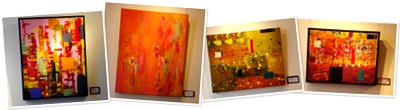
Through Urban Settings, we witness Hoffecker’s visualization of urban life that compels us to relinquish literal identification of city existence for a sincere, intangible understanding of the metropolitan experience. Incorporating snippets and traces of artifices of the world we inhabit, enigmatic layered allusions to history superimpose drenched colour to ascertain a provocative discourse about urbanity. Hoffecker acknowledges the experience can be stark as the unbleached linen she employs or as mesmerizing as the resin glow. She gives us a privileged insight into her lucid analysis. Ira Hoffecker takes us on an unfolding journey.
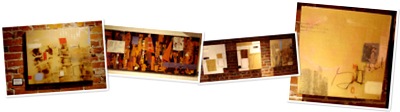
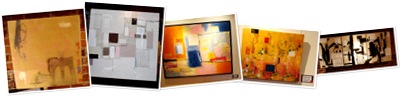
Friday, April 23, 2010
Yuri Arajs and Christian Nicolay by Debora Alanna
Point of Reference
View Art Gallery
104-860 View Street
Victoria, BC V8W 3Z8
9 April – 8 May 2010
Whether we are transported to where “every known superstition in the world is gathered into the horseshoe of the Carpathians as if it were the centre of some sort of imaginative whirlpool...” [i] [Faith in Mythology- Nicolay ‘lay down’ and installation], or to the withstanding of whirlwind cycles, luckily miniaturized and accounted for within [Two Hundred and Seventy Tornados - Arajs], we are presented with a “Point of Reference”. At the View Gallery, Yuri Arajs and Christian Nicolay concurrently show individual viewpoints, implicitly referring to a personalized vocabulary of material, comportment and meaning. Deferential to found objects or materials, each artist yields to reclaimed matter, imbedding or challenging inference and allowing a departure of imagination to develop further. “Point of Reference” provides a summit to consider probing exploration and stimulate discovery.
Arajs deftly metamorphoses rusted metal and knotted wood into weathered vistas that direct us to reflect on artful landscaping. Surfaces smartly marked with scores, lithely applied paint, spots of pigment and layers of tempered stratum juxtapose with sheets of abrasion to recalibrate a presupposition that may occur with horizontal demarcation. Attrition through weathering becomes rue, an affecting territory. Encircling within atmospheres, cell-like features intensify horizons with insistent clarity. Cheerful dots speak, sometimes as monologue expositions [Untitled (Silver Moon) and Untitled (Island Landscape)], or vexing duet [Untitled (Point of Impact)], often gathering in chorusing clusters to adorn, enunciate the pictures’ voice as charming triggers [Untitled (red landscape)] and [Floral (#11), (#6), (#21) / Kirsu Koks1 & 2 (Cherry Tree 1 & 2)]. Alluring and mesmerizing, they conjure remote celestial bodies or plot floral accents that toy seriously. [Untitled (Kelowna)] references trenchant flurry, grounding and segregating the horizon of fire with gritty underpinning. Arajs consistently transforms unpretentious material through vociferous amalgamation, creating contemplative expanse.
Nicolay works with diachronic referencing, developing a visual linguistic through found, then engaged objects and imagery. Each work confidently reveals stories that encapsulate stages of idea deliberation and augmentation. He uses a medley of means to record his empirical processing, often building the descriptors over several years. Nicolay bluntly documents validation and justification within relationships, [I like cats, she’s the dog] and [Faith in Love], queries and thwarts trust and reliance [Faith in Money]. He questions the source of edification and acknowledges confused communication with ineffectual chalkboard erasers, their erasing function supplanted with chalk stalks and Chia growth / demise [Tower of Babel]. These works are conniving recounts of Nicolay’s quests, which wily commentate with commitment and spry enthusiasm.
[i] Stoker, Bram. “Dracula.” 1897. Free Public Domain E-Books from the Classic Literature Library
Video
View Art Gallery
104-860 View Street
Victoria, BC V8W 3Z8
9 April – 8 May 2010
Whether we are transported to where “every known superstition in the world is gathered into the horseshoe of the Carpathians as if it were the centre of some sort of imaginative whirlpool...” [i] [Faith in Mythology- Nicolay ‘lay down’ and installation], or to the withstanding of whirlwind cycles, luckily miniaturized and accounted for within [Two Hundred and Seventy Tornados - Arajs], we are presented with a “Point of Reference”. At the View Gallery, Yuri Arajs and Christian Nicolay concurrently show individual viewpoints, implicitly referring to a personalized vocabulary of material, comportment and meaning. Deferential to found objects or materials, each artist yields to reclaimed matter, imbedding or challenging inference and allowing a departure of imagination to develop further. “Point of Reference” provides a summit to consider probing exploration and stimulate discovery.
Arajs deftly metamorphoses rusted metal and knotted wood into weathered vistas that direct us to reflect on artful landscaping. Surfaces smartly marked with scores, lithely applied paint, spots of pigment and layers of tempered stratum juxtapose with sheets of abrasion to recalibrate a presupposition that may occur with horizontal demarcation. Attrition through weathering becomes rue, an affecting territory. Encircling within atmospheres, cell-like features intensify horizons with insistent clarity. Cheerful dots speak, sometimes as monologue expositions [Untitled (Silver Moon) and Untitled (Island Landscape)], or vexing duet [Untitled (Point of Impact)], often gathering in chorusing clusters to adorn, enunciate the pictures’ voice as charming triggers [Untitled (red landscape)] and [Floral (#11), (#6), (#21) / Kirsu Koks1 & 2 (Cherry Tree 1 & 2)]. Alluring and mesmerizing, they conjure remote celestial bodies or plot floral accents that toy seriously. [Untitled (Kelowna)] references trenchant flurry, grounding and segregating the horizon of fire with gritty underpinning. Arajs consistently transforms unpretentious material through vociferous amalgamation, creating contemplative expanse.
Nicolay works with diachronic referencing, developing a visual linguistic through found, then engaged objects and imagery. Each work confidently reveals stories that encapsulate stages of idea deliberation and augmentation. He uses a medley of means to record his empirical processing, often building the descriptors over several years. Nicolay bluntly documents validation and justification within relationships, [I like cats, she’s the dog] and [Faith in Love], queries and thwarts trust and reliance [Faith in Money]. He questions the source of edification and acknowledges confused communication with ineffectual chalkboard erasers, their erasing function supplanted with chalk stalks and Chia growth / demise [Tower of Babel]. These works are conniving recounts of Nicolay’s quests, which wily commentate with commitment and spry enthusiasm.


[i] Stoker, Bram. “Dracula.” 1897. Free Public Domain E-Books from the Classic Literature Library
Video
Friday, April 16, 2010
Jan Johnson by Debora Alanna
Jan Johnson’s sculpture is climatic. Eight of Johnson’s works contribute to the Urban Settings show at the Dales Gallery. His distinctive welded steel and ‘found objects’ , discarded metal remnants, merge and culminate in constructions that surpass the authenticity of the raw and cast-off matter found in urban locals. Although Johnson’s materials refer to the urban build, he dwells on the exacting experiences that are a consequence of urbanity. Shrewdly, Johnson’s pieces disclose perspicacity. Each an individual world, the works reveal meanings of extensive ideas that result from experiencing an urban life. These sculptures bristle, maximizing the methodical bonding of metal, realizing tantalizing allegory.
With God of Unforeseen Consequences, Johnson may allude to a god like Chacmool, Tenochtitlan – Aztec; however, his work shunts this resemblance with the tree extension from the god’s groin. This work celebrates the outbreak of capacity possible when we acknowledge the mysterious corollary of inspiration.
Garden of Delights involves Hieronymus Bosch’s influence. Johnson’s version minutely renders the delight of cavorting around two exposed, twisting pinnacles and the angst of the never-ending party. The dry vessel that holds this extravaganza remarks on the enchantment of revelry. Too much delight parches our sensibilities. What can purify and cultivate growth of positive spirit, in excess, can desiccate and diminish beauty.
Time Saving Truth From Falsehood is a sculptural parable. The story balances on a corroded disc indicative of a faceless clock, where Time shoulders Truth, impaling Falsehood. Time’s piercing spear forms a style on the plate, where integrity prevailing over perversion perpetually triumphs.
Framing the Birth of Adam in a deteriorated flat screen TV, we become privy to the entrapment of a legendary numinous event. Bedraggled hangings enmesh lounging Adam and the pointing finger that brought him to life. Johnson makes us voyeurs to this dilapidated launch. This version of Adam’s birth is a commentary on our need to see an event on TV to believe its veracity, and the decay of belief in a mystical spectacle.
Market Goddess rules over the minions scrambling up a mechanism of archaic commerce, the oxidized innards of a metal cash register. Sycophants cluster in the backside, as well. Johnson’s edifice shows how ruthless business belittles those that worship money.
Johnson is at ease constructing universal concepts, capturing the core of metaphor, symbol and more. Sinews of metallic components, elaborately wrought, produce sumptuous contributions to our understanding of disproportionate regulation (Policy Machine), susceptibility to opportunism (Arc) and the isolating disclosure of influence (Trinity). Johnson’s sculptures are encapsulated chronicles intricately told.
© Debora Alanna
Urban Settings : Jan Johnson sculpture with abstract paintings by Ira Hoffecker
Dales Gallery -537 Fisgard St, Victoria BC
8 April – 4 May 2010 Video

With God of Unforeseen Consequences, Johnson may allude to a god like Chacmool, Tenochtitlan – Aztec; however, his work shunts this resemblance with the tree extension from the god’s groin. This work celebrates the outbreak of capacity possible when we acknowledge the mysterious corollary of inspiration.
Garden of Delights involves Hieronymus Bosch’s influence. Johnson’s version minutely renders the delight of cavorting around two exposed, twisting pinnacles and the angst of the never-ending party. The dry vessel that holds this extravaganza remarks on the enchantment of revelry. Too much delight parches our sensibilities. What can purify and cultivate growth of positive spirit, in excess, can desiccate and diminish beauty.
Time Saving Truth From Falsehood is a sculptural parable. The story balances on a corroded disc indicative of a faceless clock, where Time shoulders Truth, impaling Falsehood. Time’s piercing spear forms a style on the plate, where integrity prevailing over perversion perpetually triumphs.
Framing the Birth of Adam in a deteriorated flat screen TV, we become privy to the entrapment of a legendary numinous event. Bedraggled hangings enmesh lounging Adam and the pointing finger that brought him to life. Johnson makes us voyeurs to this dilapidated launch. This version of Adam’s birth is a commentary on our need to see an event on TV to believe its veracity, and the decay of belief in a mystical spectacle.
Market Goddess rules over the minions scrambling up a mechanism of archaic commerce, the oxidized innards of a metal cash register. Sycophants cluster in the backside, as well. Johnson’s edifice shows how ruthless business belittles those that worship money.
Johnson is at ease constructing universal concepts, capturing the core of metaphor, symbol and more. Sinews of metallic components, elaborately wrought, produce sumptuous contributions to our understanding of disproportionate regulation (Policy Machine), susceptibility to opportunism (Arc) and the isolating disclosure of influence (Trinity). Johnson’s sculptures are encapsulated chronicles intricately told.
© Debora Alanna
Urban Settings : Jan Johnson sculpture with abstract paintings by Ira Hoffecker
Dales Gallery -537 Fisgard St, Victoria BC
8 April – 4 May 2010 Video
Thursday, April 15, 2010
Augustus Magus for exhibit-v!
We are pleased to announce that Augustus Magus will be other of our contributors to the new section WRITE-UPS !
Augustus Magus
* BFA (Visual Arts, Honours), University of Victoria, Victoria, BC.
* Film and Video, Emily Carr University of Art + Design, Vancouver, BC.
Augustus Magus
* BFA (Visual Arts, Honours), University of Victoria, Victoria, BC.
* Film and Video, Emily Carr University of Art + Design, Vancouver, BC.
Thursday, April 8, 2010
Grant Watson –Sculptfiction- by Debora Alanna
Grant Watson’s show, Sculptfiction displays a broad oeuvre of 17 sculptures. The range of his deft vigour is evident in Calle Muro and his ability to demonstrate edifying, confident humour is unmistakable in Before I Lay Me Down To Sleep. His work narrates, describing insight through sculptural investigations. Watson’s inventive material use and most importantly, a considerate deliberation of various human experiences delivers jostling perspectives through witty visual banter, seductive colouration, calculated texture and wistful sculptural practice.
Lectern is a podium for raising our understanding of intense, primal activity. Like a yoni-lignum, Watson embodies the sexuality of human interaction through the structural integrity of emblematic forms. A multifaceted, undulating and corrugated shape clutches an extruded sphere on one side of a waveform. An unyielding phallic fringe, secured by a carved petal relief pokes out at the edges of the void hemispheric cavity on the other half of this interpretive duality. This taunt encourages visceral contact, enticingly and pawing simultaneously. The edging constructs a protective picket. Inside the opposite embracing waveform, similar picketing surrounds the extruded sphere within the encirclement. Watson expounds the opposing contrasts of yes and no, of open and closed, where our perpetual symbiotic dichotomy is in constant flux.
Watson’s Private Idaho measures forfeiture. He describes precarious development, which induces displacement of domesticity. Perched on top of a yellowed ovoid is a vacant white house icon. Watson dares to acknowledge the valued presence of sloppy oozing, ideas that collect brightly and separately, in spite of attentive maintenance to balance - the forfeit. This undefined green substance is the genesis of new opportunity cradled in the unique measuring mechanism that supports the tilting elliptical symbol of contrived optimism.
How Owed Are You cunningly refers to the tiny music box that turns the tune ‘Happy Birthday’ found in the centre of this brash wall work. Redness shouts robustly; however, tool marks, subtle below the red-stained surface gently caress the studded plane, placating the need to remember antecedents to this presentation of assertiveness.
Figurative works include the wall sculpture, I Dream in Red. A boy’s vulnerability is perched on a pyramid of steps. The red arched background shrouds his dream state, which truncates his mind from his body. Ballooning ideas hover above. Here, Watson’s whimsy balances the significance of this narrative. The dreamer cannot see the strength that supports him, the walled structure below, concealed by delineated steps. A wall of bricks under the dreamer is firm yet sometimes protrudes. This construction reveals potency and strength that supports innocence, which is impressionable. Watson’s construct of the future shows narrates how we are dependent on the consequence of the dream. All dreams. Grant Watson’s work is the result of disciplined dreaming.
Grant Watson Website
video
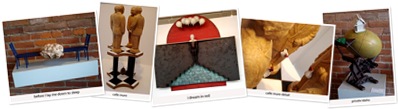
Lectern is a podium for raising our understanding of intense, primal activity. Like a yoni-lignum, Watson embodies the sexuality of human interaction through the structural integrity of emblematic forms. A multifaceted, undulating and corrugated shape clutches an extruded sphere on one side of a waveform. An unyielding phallic fringe, secured by a carved petal relief pokes out at the edges of the void hemispheric cavity on the other half of this interpretive duality. This taunt encourages visceral contact, enticingly and pawing simultaneously. The edging constructs a protective picket. Inside the opposite embracing waveform, similar picketing surrounds the extruded sphere within the encirclement. Watson expounds the opposing contrasts of yes and no, of open and closed, where our perpetual symbiotic dichotomy is in constant flux.
Watson’s Private Idaho measures forfeiture. He describes precarious development, which induces displacement of domesticity. Perched on top of a yellowed ovoid is a vacant white house icon. Watson dares to acknowledge the valued presence of sloppy oozing, ideas that collect brightly and separately, in spite of attentive maintenance to balance - the forfeit. This undefined green substance is the genesis of new opportunity cradled in the unique measuring mechanism that supports the tilting elliptical symbol of contrived optimism.
How Owed Are You cunningly refers to the tiny music box that turns the tune ‘Happy Birthday’ found in the centre of this brash wall work. Redness shouts robustly; however, tool marks, subtle below the red-stained surface gently caress the studded plane, placating the need to remember antecedents to this presentation of assertiveness.
Figurative works include the wall sculpture, I Dream in Red. A boy’s vulnerability is perched on a pyramid of steps. The red arched background shrouds his dream state, which truncates his mind from his body. Ballooning ideas hover above. Here, Watson’s whimsy balances the significance of this narrative. The dreamer cannot see the strength that supports him, the walled structure below, concealed by delineated steps. A wall of bricks under the dreamer is firm yet sometimes protrudes. This construction reveals potency and strength that supports innocence, which is impressionable. Watson’s construct of the future shows narrates how we are dependent on the consequence of the dream. All dreams. Grant Watson’s work is the result of disciplined dreaming.
Grant Watson Website
video
Tuesday, April 6, 2010
Debora Alanna for exhibit-v!
We are pleased to announce that Debora Alanna will be other of our contributors to the new section WRITE-UPS !
I write about sensibilities projected by work considered. I discuss the essence, what is contingent to the art, what is projected. Art succeeds to transform our understanding. My writing features these observable facts.
In the 90’s the Hong Kong publisher, Ian Brown of Asian Sculpture News, now World Sculpture News included my articles on sculptural practice - individuals and group expositions in his publication. The Times of India, Ahmedabad published my features on culture, relationships connecting architecture and urbanity, and the culmination of curators’ visions in group exhibits. For the last decade, my professional writing, utilized by non-profit organizations, has facilitated consideration of pertinent public issues.
A graduate of Ontario College of Art, my art practice has enabled expositions in Brazil, Kazakhstan, Spain, France, Italy, India and Canada. My new home, Victoria, is creating vitalizing developments in my career. Writing for Exhibit-v is a welcome opportunity to share my observations about art in this on-line context. In my writing, I will discuss art to further the artist’s audience. I consider myself an advocate for artists. Your views about my explications are welcome.
Blog
I write about sensibilities projected by work considered. I discuss the essence, what is contingent to the art, what is projected. Art succeeds to transform our understanding. My writing features these observable facts.
In the 90’s the Hong Kong publisher, Ian Brown of Asian Sculpture News, now World Sculpture News included my articles on sculptural practice - individuals and group expositions in his publication. The Times of India, Ahmedabad published my features on culture, relationships connecting architecture and urbanity, and the culmination of curators’ visions in group exhibits. For the last decade, my professional writing, utilized by non-profit organizations, has facilitated consideration of pertinent public issues.
A graduate of Ontario College of Art, my art practice has enabled expositions in Brazil, Kazakhstan, Spain, France, Italy, India and Canada. My new home, Victoria, is creating vitalizing developments in my career. Writing for Exhibit-v is a welcome opportunity to share my observations about art in this on-line context. In my writing, I will discuss art to further the artist’s audience. I consider myself an advocate for artists. Your views about my explications are welcome.
Blog


No comments:
Post a Comment