Saturday, September 15, 2012

Jeroen Witvliet - Days - Slide Room Gallery - August 2012 - Review by Debora Alanna

Thursday, September 13, 2012


Jeroen Witvliet show “Days” reviewed by Debora Alanna

IMG_6209 IMG_6214 IMG_6216 IMG_6217 IMG_6220

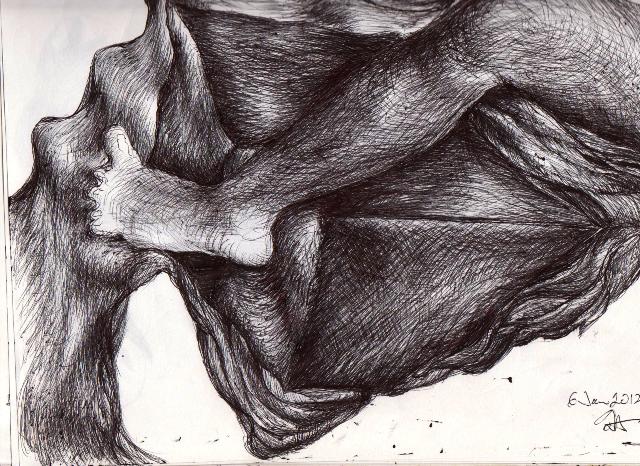
Entering Days, Jeroen Witvliet’s epic drawings loom, overpower any thought brought to the Slide Room Gallery threshold, drawing one completely into his disquieting and imposing work. Drenched with charcoal biting stark, thick white paper, attentively drawn distressed entanglements emphasize spectacle, vistas of loaded feelings conspicuous in heaps of tousled matter and defeated branches. There is a line in Aristotle’s poetics Part IV that this work embodies, ‘Objects which in themselves we view with pain, we delight to contemplate when reproduced with minute fidelity’. ([1]) With commitment to detail, Witvliet produces contemplative stanzas of a tragic poem. Days drawings are knotty discussions about ruin providing startling lucid factious narratives. His imagery taunts our perception of how days of time influence disaffecting internal conflicts.

Unlike Webster and Noble's trash pieces that create coy figurative shadows projected from the waste configuration, Witvliet’s debris piles, although seemingly rendered as haphazard, are judicious figuration explorations as well as suspended ground, a composite relation. With the intensely described veneer of ruin the remnants of civilization’s abandon and forestal foray figuratively repose as mounds. Versed in quantification and evaluation of remains, Days untitled drawings exhibit a range of possibilities for correlated dissemination, while considering its impact, and resolve, heroically complex.

From Russell Perkins', Adorno's Dreams and the Aesthetic of Violence. Telos 155 (Summer 2011). :
Adorno is never merely a passive bystander to suffering. [...] we see that insight into violence only becomes possible when neutrality is foregone for standpoints of ambivalent participation, and thus that the suspension of the category of witness becomes the very condition of possibility for testimony.
Theodor W. Adorno, (1903 –1969), German sociologist, philosopher and musicologist, known for his critical theories of cultural industry, with Max Horkheimer (1895–1973), had insight into the passive danger imposed on human needs by mass consumption.([2]) Compositional vocabulary, whether sound or visual composition, relates the audience to cultural dissonance when presented with intense scenarios as seen in Days. An Adorno like metaphor, the passivity of elegant debris ambivalently engages is a witness to violent disregard, a poignantly portrayed testament - Schoenbergian atonality personified. WithDays, we see that Witvliet also is not a bystander to suffering because his work is a demonstration of universal untamed forces that disseminate within us all. Days is evidence, imagery dishevelled with violent overtones.

Witvliet’s Days has uncanny erotic tension within the load of implicit piles of expressive remnants’ and/or broken branches coexisting, memories upon memories tangled. In Ralf Waldo Emerson’s poem, Days, he speaks of his ‘pleached’ garden. Witvliet’s pleached wreckage, woven with civilization’s discard and denuded trees is the Garden, reverential intimacy scorned. The politics of duplicity is inscribed in the torn and stinging lines he makes whipping up from the white paper wasteland, spilling shadow.

Orgone, Reich & Eros, Wilhelm Reich’s Theory of Life Energy by W. Edward Mann, on page 159, quotes from an article by Richard Martin, “Be Kind to Plants – Or You Could Cause a Violet to Shrink,” in The Wall Street Journal, Wednesday, February 2, 1972 to substantiate Reich’s claim that ‘orgone energy pulsates through all living systems and that all are interdependent, existing in a kind of energy ocean.’ Wilhelm Reich called his hypothesized universal life force orgone. He claimed orgone is imparted from all organic material, which ostensibly can be captured with a booth-like device to restore psychological health.

Two of Witvliet’s drawings are plants under glass, or see-through boxes and there is another drawing of a seemingly abandoned greenhouse snugly enclosed by a mishmash of forest debris – the residual forest darkness standing distant. Hans Haacke's "Condensation Cube" (1963), displays transformative energy as condensation, collected or at least contained, without vegetation because Haacke has transplanted weather indoors, detached from growth, and presumably orgone. Witvliet’s greenhouse rendering, with this theory, is a very big organic energy collection box with a spiritual aesthetic seen in Gerhard Richter’s Iceberg in Fog (Eisberg im Negel) (2002). Human interaction has forced the forest surround into submission, while the trees still stand behind the greenhouse are expectant reminders of how energy can be cultivated, although, directed by human foible amassed energy can also abuse, destroy. Witvliet measures our collective psychological health and tells us the forest is shrinking, and our energy ocean is as segregated and minimal as a Haacke condensation cube. This is not a theory.

In a video performance, a reinvention of Allan Kaprow’s Art is Life (1964/2008), at The Museum of Contemporary Art, Los Angeles (MOCA) presented by Outpost for Contemporary Art on April 19, 2008, a segment called “Household Revisited”, where (according to MOCA) ‘Peaceniks, Treehuggers and other Believers’, in the midst of household debris (some human size), chant:

We lie where we will
What if every cell in our body is in dialogue with all there is?
Imagine the world you can’t imagine.
Imagine being accepted.
Junk, piles of people.

Household remnants strewn and piled in a field was a rebellion against the accoutrements of banality, while the Believers implore for liberation from the idea that people represent themselves by what they own. Witvliet’s immobilized masses of liberated stuff, many pieces laded in handsome adjacent squares, networks of distribution, and even muddled masses spare the association of ‘Junk, piles of people’. Figurative, yes, but his imagination has been long liberated from literal references, enabling mottled shreds of interactions to blanket the mounds.

On 11 September 2012, The UK daily, the Telegraph reported ([3]),”the massive floating islands of garbage, some almost 70 miles in length, caused by last month’s tsunami in Japan, which are causing chaos in shipping lanes in the Pacific Ocean, as they slowly head for the west coast of the America.” As Witvliet’s piles seem to float, they do incite a kind of chaos, blockage, a revelation of a disturbance and trauma. In his artist statement, he refers to the image within his refuse drawings as, “A raft lost at sea.”

In Jorge Luis Borges’ preface to "The Invention of Morel", a novel by Adolfo Bioy Casares, about an island of intrigue, he writes that full freedom leads to full disaster, global warming’s weather demise contributing, as the news item above attests. What Borges calls the fictitious nature of politics as a means to freedom through the ordering of society is punishingly unable to originate mysterious, and reasonable facts the author, Casares can contrive. We have to wonder about the politics of materialism that the floating ocean island of debris in the news above created, and what disorder allows the menace to continue to pollute. Witvliet’s islands of dishevelled matter are the result of unrestrained loads, where chaos has created the enigma of mess and confusion. What Witvliet creates is a delicate wisdom, as Borges would say, to transcribe intangible, mysterious veracity. Magritte said, ‘The mind loves the unknown. It loves images whose meaning is unknown, since the meaning of the mind itself is unknown.” ([4]) Witvliet, akin to Borges’ Casares, renders the unknown as archetypal insight and with his mindful power of depiction, articulates the mysterious with demonstrative candour.

In Edgar Allen Poe’s poem, Enigma, hiding the name of a fellow poet in its text, to express how she was unacknowledged in her lifetime, he writes, “through all the flimsy things we see at once”[...]”Trash of all Trash”. [...]”But this is now – you may depend upon it –/Stable, opaque, immortal – all by dint/Of the dear names that he concealed within’t.” The enigma, here being the baffling unknown reason his friend’s poetry was not recognized in spite of her profundity. Witvliet’s drawings, too are veiled gems, enigmatic discourses on life’s inconsistency and the mortal need for rapport. As we, with ambivalence render our vision opaque, we are reticent to see the concealments of powerful, universal truths in perilous collections of thought as his piles of debris describe. Witvliet’s Days is significant, enduring memory that pictures weighted introspection. His denouement of our collective tragedy, the revelation is confrontational pain. Through the mourning of Days, we are wakening.

[1] http://classics.mit.edu/Aristotle/poetics.1.1.html
[2] Adorno, T. W., with Max Horkheimer. Dialectic of Enlightenment. Trans. Edmund Jephcott. Stanford: Stanford UP, 2002. 242.
[3] http://www.telegraph.co.uk/news/worldnews/asia/japan/8437632/Massive-floating-rubbish-islands-from-Japan-tsunami-spotted-on-Pacific.html
[4] RenĂ© Magritte (1898-1967), Belgian surrealist painter. Quoted in Suzi Gablik, Magritte, ch. 1 (1970).

Slide Room Gallery
Vancouver Island School of Art
Victoria BC
August 2012

Jeroen's website : www.structure365.com


Tuesday, August 14, 2012

Video - Everything Else is Winter

Exhibit-v produced and posted this video of my show, "Everything Else is Winter" at Xchanges Gallery.
http://www.exhibit-v.ca/

Saturday, August 11, 2012

Review of "Everything Else is Winter" by Philip Willey - from Exhibit-v

http://exhibit-v.blogspot.ca/2012/08/debora-alanna-everything-else-is-winter.html


Saturday, August 11, 2012

Debora Alanna - Everything Else Is Winter – by Philip Willey

Beach Debora   Remains of the Day Debora Do Not Let Fear Win denboraBeyond the Beguine debora
 
One thinks of Arte Povera, the art movement that grew up mainly in Italy in the Sixties as a reaction to the elitism of the art world and to more general social injustice. But whereas Arte Povera makes a political statement Deborah Alanna seems more concerned with the emotive power of materials. Her work bursts of the walls. There is something primeval about it…..a primitive force that can’t quite be contained. As she says in a statement: "My sensibilities are founded in the unconcealed world that has dimensions to be discovered. Disparate thoughts can suggest possibilities I love to explore." What, one wonders, is she doing in Victoria with its well-manicured calm?

She left Vancouver because her life there was becoming too intense she says. She needed calm and detachment and like so many she found Victoria a good place to make art. It has been a productive move for her as scores of preliminary drawings attest.

Alanna has held solo exhibitions of sculpture in Kazakhstan, Italy, France, India, and Canada and participated in group exhibitions in USA, Brazil, Spain, France, Italy and Canada. She describes herself as a sculptor primarily but finding herself restricted by lack of space. So for some time she was limited to drawing on paper.

The drawings appear to be studies, ideas and imaginings which may lead to future three dimensional work. Forms in the drawings are fundamentally organic and somehow reminiscent of Anish Kapoor’s refined seedpod-like creations. The larger paintings are sculptural in the way of Schnabel and Kiefer where various materials are compounded to produce a rich texture that is at once spontaneous and the result of studied choices. Contrasts are stark and every piece in the show has visual impact. The titles, one suspects, come after or during the fact.

The overall impression is one of strength. Underlying all the work one senses a kind of magma.the primeval brew at the center of the universe. The emotional energy in this work is quite overpowering really and it requires a conscious effort to resist being engulfed. The paintings become progressively more sculptural as Alanna starts to concentrate on an upcoming show in Iceland to be called, appropriately, ‘Lava and Light’.


Xchanges Gallery - August 2012


Friday, August 03, 2012

New paintings


Medico Della Peste - Acrylic, plaster & wire on board - 8 X 10 inches


Do not let fear win - Acrylic, plaster, wire, styrene & glue on aluminium - 12 x 14 inches


Beyond the Beguine - Acrylic, plaster, moss, fabric, glue, bamboo on canvas - 16 x 18 inches

Saturday, July 07, 2012

"Everything Else is Winter"

https://www.facebook.com/events/444279672261325/


  • Exhibition of drawings & paintings in various media by Debora Alanna

    http://embellish4art.blogspot.ca/

    http://www.flickr.com/photos/embellish4art/

    This exhibition includes drawings on paper, with bic pen and oil pastel, and mixed media paintings. All work is for sale. Posters of selected works will be available, as well.

    "Everything Else is Winter" is a body of work produced during and just after a year spent in a transitional shelter due to traumatic events, and 6 months after leaving. All works explore emotional states through this journey.

    “My sensibilities are founded in the unconcealed world that has dimensions to be discovered. Disparate thoughts can suggest possibilities I love to explore. I am a conceptual thinker; multidimensionality, space and time are used in the realm of my art practice. Conventional thoughts about material use are continually challenged in my work.”

    Debora graduated from the Ontario College of Art and Design in Experimental Art. She has held solo exhibitions in Italy, France, India, Kazakhstan and Canada, and group exhibitions in India, France, Spain, USA, Brazil and Canada.

    Title of this exhibition is courtesy of Joey Goodwin.


      • August 6
         at 12:00pm
         until August 11 at 5:00pm

Friday, June 22, 2012

Black Mountain


"Black Mountain", inspired by Besse Smith's song. 


12" x 12" aprox. - Acrylic on scored aluminium with fencing. 


Exhibited in the Deluge Contemporary's 'RPM - The lost art of LP covers' this evening (22 June 2012).

Photo by Philip Willey


Wednesday, April 25, 2012

Brad Pasutti - New Paintings - Review by Debora Alanna

Here's my latest review about Brad Pasutti on the Exhibit-v blog April 3 to 28, 2012 Winchester Gallery 2260 Oak Bay Ave Victoria BC

Monday, April 02, 2012

Red Shoes

It occurred to me, that all my childhood I was striving to be worthy of red, pointy-toed velvet shoes with the sparkling diamond clasp that remained on the top shelf of my mother's linen closet, destined for my sister's four year old feet, feet that refused to wear shoes. When the store master at the Dog Patch corner store determined my feet were squishy when seen in flip-flops one prairie summer, I longed for the power of those alluring shoes, still waiting for my sister's submission. I cradled my dripping orange Crush. It didn't matter that the impossibility of August heat kept those shoes in the dark, cool cupboard . Or that my feet were four years bigger than the shoes. My round toed brown leather Buster Brown's did not defend my honour in September, and the red tempting prize continued to perch where they would live forever. In my memory, I still climb up to touch velvet expectation. And orange Crush still comforts.

Thursday, March 29, 2012

Room upgrade for Pacific Northwest afternoon - Robert Youds - Deluge Contemporary Art - Review by Debora Alanna

Thursday, March 29, 2012


Room upgrade for Pacific Northwest afternoon by ROBERT YOUDS review by Debora Alanna

Deluge Contemporary Art
636 Yates Street
Victoria, BC, Canada
9 March - 15 April 2012

clip_image002


Room upgrade for Pacific Northwest afternoon is an allegorical poem, a collection of works that stand individually yet interact as illuminated poems hearkening, aware of mortality, or, stanzas of an epic that encompasses abstract ideas - resonant timelessness. Interacting with composed light, colour and shape, texture and form, Youd’s ideology dispels a disposition of power and liberation, a vigilant temperament made palpable through urban vernacular. His material relationships respond spatially and texturally within each work and amongst the works exhibited, echoing the considerable evidence of affecting time with light as the means to expand his discourse, poetically.


Ericson’s cabin

clip_image004 clip_image006

Housed in an opaque light box, Erickson’s cabin beams with Youds timed sunshiny light apparatus among mysteriously illuminated hidden shapes. Involving a patch of thin, layered cedar slats mounted on the top right corner, Youds tells a cabin story, a story of isolation where thought processing is demonstrated. Confined in a box, ambiguity of imperfect form is toughened by the unyielding sheath containing the instrumentation. Contrasting the rough and emotional reality of wood symbol with expressive shadow interplay within the three-dimensional window, a portal to intimacy possible in the confines of an ordinary cabin-life and distilled living is achieved.

In Arthur Erickson’s address to McGill School of Architecture students, 21st of October 2000, Erickson talked about how “Out of the most ordinary circumstances a transcendental experience is distilled. Though lacking in cerebral challenge, since it is beyond the limits of the brain it gives its viewers a sense of highest fulfillment. “Robert Youds said, at a recent Q & A for Megan Dickies’s University of Victoria class held at the Deluge visiting Youds exhibition, “Room upgrade for a Pacific Northwest afternoon, “I distill down what’s on my mind.” Youds allows us to glean the mottled, consistently changing unevenness within a mystery, attached to the stiff, refined wooden sheaths, the surround of cabin dwelling, combined, is the means to exist beyond the material world, which is at the heart of this tone poem.


turn on your electric

clip_image008 clip_image010


clip_image012

Identified with cabin life in the Pacific North West, turn on your electric holds a surfboard in the clarity of triangulated colour patches, mapping what cannot be obtained or used. A dream beholden to prospective scenarios. Echoing the patch of wood on Erickson’s cabin,the placeholder for contemplation, these lucid patches blush and influence electrifying possibilities embodied by the loafing board. This work has inspiration placed sideways, Carpe diem, seizing contrition, barred from a dream, the allusion to hope is nearly a glossy, tinted Incandescence, crossed by bands of florescence and Youds insists a command will enable change.

Youds provided a bench for viewers to look through the tented work on its window side, so the whole gallery of pieces become coloured by pinks, red and turquoise squaring commanding fantastic, recreational simultaneousness, and turn electric with engaging multiplicity.

usonian Cave

clip_image014 clip_image016

This work requires some preface.
In 1903, in his book, “Here and There in Two Hemispheres” [1], James Law coined the word Usonian, a means of describing something exclusively American, as in of the United States of America. The term was later employed by the architect Frank Lloyd Wright, who designed Usonian dwellings, homes that were post-war practical and economical for the baby boomer families. Wright, in his Selected Writings 1894–1940 considered the writings of Samuel Butler, an author that also employed the Usonia concept, to explain his architecture for straightforward, utilitarian, yet homey homes. Arthur Erikson, a familiar Pacific Northwest (Canadian) architect escaped to travel, but did not escape Wright’s “absolutely beautiful blending of building and landscape." [2] influence which he developed in his own commanding, spiritually receptive with sensitivity to light and the surrounds he built within.

The Greek philosopher, Plato as part of his work, The Republic, included The Allegory of the Cave to demonstrate “our nature in its education and want of education” (514a), is a fictional dialogue between Plato’s teacher Socrates and Plato’s brother Glaucon at the beginning of Book VII. The Allegory of the Cave is preceded by the metaphor of the sun (507b-509c) and the analogy of the divided line (509d-513e).

In the cave, a group of people chained to a central partition inside the cavern, immobile all of their lives, face a blank wall where shadows project on the wall by things passing along a walkway in front of a fire behind them. In the story, Socrates elucidates that the shadows are the prisoner’s view of reality. He explains how the philosopher is like a liberated prisoner, who comes to understand that the shadows he looked at when forced to face forward only are not essential to the particular nature of the objects or entities that made shadows. The Allegory relates to Plato’s Theory of Forms, where “Forms” or “Ideas” and not the changeable material world known to us through sensation, and possess the epitome of reality. Accordingly, only knowledge of the “Forms” establishes true knowledge.

An aria, a solo song of intricacy, with usonian cave, Youds suspends the Usonian ideology and combines Plato’s allegorical cave where chains of connotation dangles. Youds hangs reality. With printed chains on acetate, blackening shadows flicker in square neon variation, chinks freed on the fixture. The Usonian, or everyman’s cave, a home for the free, is a place where ideal truth can be found, if released from the fetters that diminish spiritual veracity. The flash of square forms reiterates ideas that are timelessly tested. Is the Usonian concept caving into the shadows of perfection? Is a philosophy that enlightens ruined by structure? Youds materializes sensation with ideals.

wood is resilient in earthquakes

clip_image018


clip_image020 

A peek into the naked framing of the work, wood is resilient in earthquakes, Youds exposes the yellow light of fear, the heart of how the absence of concrete applications affects this tragic poem - believing in security does not make it so. A landscape of grey tones with horizontally awry tubing disturbs the embedded parallel fixture. The oblong wood feels protective as it houses the blocks of glassy gradation. Resilient, the wooden hold has trusting structure, but here, faith is an imperfect scheme. Resilience has value; however, the quaking earth can test horizontal toughness, and be found wanting. Youds reveals the view into understood vulnerability. If Tturn on your electric is a plea for living,wood is resilient in earthquakes, although an optimistic thought, is a description of the failure to be resilient. Youds grounds this opposing elegy for those who may pass, a presage of fatality in our Pacific Northwest if we do not act to protect ourselves from earth quaking certainty. Or in Prosperos’s words, “release me from your bands..now I want Spirits to enforce, art to enchant...Let your indulgence set me free” (Epilogue 1-20,The Tempest, William Shakespeare)


Room upgrade for Pacific Northwest afternoon

clip_image022 clip_image024

The namesake of Youds exhibition, Room upgrade for Pacific Northwest afternoon is a lyrical ode to life in situ, an upgrade to familiar existence within the Pacific Northwest, while evolving the room, otherwise known as our psyche or internal space, fortitude or spirit, which may relate to our physical place for consideration, and Gaston Bachelard, author of Poetics of Space, would say, and as the roofing implies an attic space, upgrading our clarity of mind.

In a person’s life, the afternoon can relate to our 50’s, where one is still active and thriving, where one can change and benefit from new shafts of light or ideas or formulations, and one is equally capable of expanding the disseminating knowledge, contributing to the world we participate in, improving it with upgraded presentment. Youds work articulates and advances Platonic metaphysics, dividing the line, multiplying it, making it vertical, active and interactive. Visibility and intelligibility are synonymous in his work. Youds makes his florescent, luminescent lines dance on a cedar rooftop, indigenous to the Pacific Northwest, framed by the square of a window that we have seen in more incisive detail in Erickson’s cabin, another kind of cave. In this work, the hold, the repose is beneath the tilting slats, protecting the mindful interiors where the form of synchronistic ideas, connected with electric possibility are simultaneously exposed and supported by the framework of straightforward, humble roofing architecture. Circular holes, discreet round apertures in the roof allow the breadth of something more, where the void is a possibility, and sublimates the sunny shines within Erickson’s cabin. Robert Youds reveals fortitude in the material of illumination through inherent, enduring inspiration, distilling the light of his poetry on us.

[1] James D. Law, Here and There in Two Hemispheres (Lancaster: Home Publishing Co., 1903), pp. 111–12n.
[2] Martin, Sandra. "The greatest architect we have ever produced," The Globe and Mail, Friday, May 22, 2009.

Thursday, February 16, 2012

Exhibit-V: Tyler Hodgins “Sleeping Bag “ review by Debora Al...

Exhibit-V: Tyler Hodgins “Sleeping Bag “ review by Debora Al...: http://aggv.ca/exhibitions/throw-down The Victoria public may have or will encounter Hodgins’ series of sculptures, “Sleeping Bag”, a bl...

Friday, February 10, 2012

Off Label by Debora Alanna (Digital Art Weeks 2011 - DAW11)


Here is the 'Report' I wrote (with pictures) on the Digital Art Weeks 2011 International event (DAW11)

'The Off Label Festival' that took place in Victoria last autumn.


http://www.digitalartweeks.ethz.ch/web/DAW11/Press?action=download&upname=OffLabelReport_ALANNA.pdf


 http://www.digitalartweeks.ethz.ch/web/DAW11/Press                                                              

Sunday, January 29, 2012